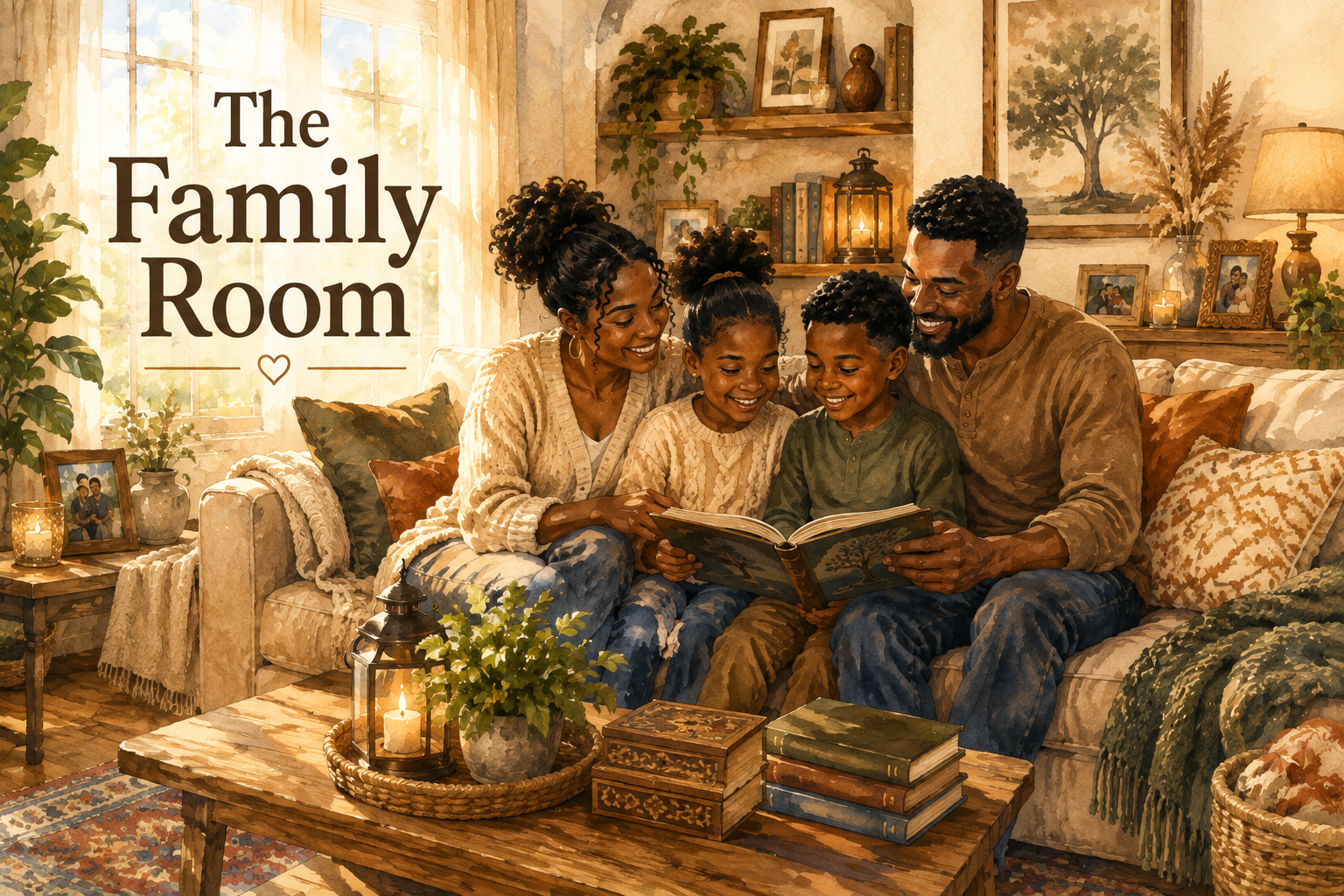
Family Room
Understand the family as a system—not just the individuals within it.
A family is more than a group of people living together or sharing a biological connection. Every person brings their own personality, experiences, needs, emotions, expectations, relationships, wounds, responsibilities, and ways of communicating into the family.
Over time, families develop patterns—some supportive, some difficult, and some passed down without anyone consciously choosing them.
The Family Room creates space to step back and look at how the family functions together, what influences its relationships, what it has inherited, what it's currently navigating, and what kind of family it's becoming.
Enter the Family Room ↓
🧭 What You'll Explore
The Family Room moves through eight areas:
Understanding Your Family System → see how individual family members affect the whole
Communication, Conflict & Repair → understand how your family communicates, disagrees, and reconnects
Relationships Within the Family → explore parent-child, sibling, co-parenting, caregiver, and other family relationships
Changes, Separation & Blended Families → navigate the ways families change shape over time
Generational Patterns & Lineage → recognize what has been passed through the family
Boundaries, Safety & Family Accountability → explore limits, protection, responsibility, and healthy family boundaries
Families Under Pressure → understand what happens when the family is navigating stress, loss, instability, or difficult circumstances
Creating the Family You Want to Become → intentionally build healthier patterns for the present and future
Personal Insights → Understand your unique family system.
Understanding Your Family System
What happens to one person can affect everyone else.
A family system is the network of relationships, roles, patterns, expectations, responsibilities, and interactions connecting the people within a family.
Family members don't function completely independently from one another. One person's stress may affect communication throughout the household. A change in one relationship can influence another. The role one person takes may cause someone else to compensate in a different way.
Families can also develop unofficial roles such as the caretaker, peacekeeper, responsible one, rebel, protector, achiever, invisible child, or person everyone turns to during a crisis.
Looking at the family as a system shifts the question from only:
“Which person is causing the problem?”
to:
“What is happening between us?”
-
“What happens with one person in a family can affect everyone around them.”
A family system is the network of relationships, roles, patterns, expectations, and interactions connecting family members.
Because those relationships are connected, changes involving one person can affect the rest of the family.
When someone is struggling, leaves the household, takes on a new role, changes their behavior, or needs more support, other family members may respond and adjust too.
Over time, families also develop patterns around communication, conflict, responsibilities, emotions, and connection.
This is why understanding a family sometimes requires looking beyond one person's behavior.
Instead of only asking:
“What is happening with this person?”
We can also ask:
“What is happening within the family around them?”
Understanding the family as a system helps us see how individual experiences and family dynamics influence one another.
-
“Every family develops its own way of doing life together.”
Family culture is created through the values, routines, expectations, traditions, communication styles, roles, and everyday behaviors that become normal within a family.
Some parts are intentional.
Others simply develop over time.
Your family may have unwritten rules about how emotions are expressed, who handles certain responsibilities, how conflict is addressed, what success means, how affection is shown, or what topics aren't discussed.
Children learn these patterns by living inside them—even when nobody explains them directly.
Understanding your family culture starts with noticing:
What has become “normal” in our family?
Then you can decide what reflects the family you want to be and what may need to change.
Family culture isn't only something you inherit. It's also something your family creates together.
Communication, Conflict & Repair
Every family develops its own way of communicating.
Family communication includes how people express needs, emotions, expectations, disagreements, affection, disappointment, boundaries, and everyday information.
Some families communicate openly. Others avoid difficult conversations. Some yell, shut down, become defensive, use another family member as the messenger, hold grudges, or act as though nothing happened after conflict.
Conflict itself doesn't automatically mean a family is unhealthy.
Repair is what happens afterward—acknowledging what occurred, listening, taking responsibility where needed, addressing hurt, changing behavior, and rebuilding connection.
Children also learn a great deal about relationships by watching how the adults around them handle disagreement.
-
“Conflict can happen in healthy families too. What matters is how the family handles it.”
Family members won't always agree.
Different needs, personalities, expectations, emotions, and perspectives can create tension—even in families that love and care about one another.
Healthy conflict allows people to disagree while still maintaining respect, safety, and room for everyone's voice.
Harmful conflict may involve intimidation, humiliation, threats, manipulation, repeated personal attacks, violence, or making someone feel unsafe for expressing themselves.
The goal isn't to create a family that never argues.
It's to build a family where disagreement doesn't require someone to be silenced, frightened, or treated like the enemy.
Ask:
How does our family treat one another when we're upset?
A healthy family isn't defined by the absence of conflict, but by how conflict is handled and what happens afterward.
-
“Repair is what happens when a family chooses to address the hurt instead of pretending nothing happened.”
Families will have moments of disconnection.
Someone may yell, misunderstand another person, break trust, say something hurtful, or handle a situation poorly.
Repair is the process of acknowledging what happened and working toward rebuilding connection.
An apology can be part of repair, but it isn't always the entire process.
Repair may also require listening to how someone was affected, taking responsibility, correcting what can be corrected, changing a repeated behavior, or rebuilding trust over time.
Not every situation can be repaired immediately, and the person who was hurt may need space.
Repair also doesn't mean pretending the harm didn't matter.
Healthy repair asks more than “Did we say sorry?” It asks, “What needs to happen so we handle this differently moving forward?”
Relationships Within the Family
There isn't only one relationship inside a family.
A single family may contain parent-child relationships, sibling relationships, romantic partnerships, co-parenting relationships, stepfamily relationships, grandparent relationships, extended-family relationships, and caregiving relationships.
Each connection can have its own closeness, history, conflict, expectations, boundaries, and power dynamics.
Someone may have a healthy relationship with one family member and a very difficult relationship with another.
Understanding the family therefore means looking at both the family as a whole and the individual relationships creating that whole.
-
“Being part of the same family doesn't mean everyone experiences the family—or each other—the same way.”
Every relationship within a family has its own dynamic.
A child may relate differently to each parent. Siblings may have completely different relationships with one another. A grandparent, stepparent, caregiver, or other family member may connect differently with each child.
These differences can be shaped by personality, age, shared experiences, roles, time together, conflict, and individual needs.
Different doesn't automatically mean unequal or unhealthy.
Problems can arise when families expect every relationship to look the same or assume one person's experience represents everyone's.
Instead, ask:
What is happening within this particular relationship?
Looking at relationships individually can help families understand where connection is strong, where tension exists, and where more attention may be needed.
A family is one system made up of many different relationships.
-
“Children shouldn't have to carry communication that belongs between adults.”
During separation, co-parenting conflict, or tension between family members, it can become easy to ask a child to pass along information.
“Tell your dad…”
“Ask your mom…”
“Let them know I said…”
But placing children in the middle can make them responsible for communication and conflict they didn't create.
It can also create pressure to take sides, keep secrets, manage adults' emotions, or worry about how one person will react to another.
Whenever possible, adult concerns should be communicated directly between the adults responsible for handling them.
Children can still have a voice about their own experiences, needs, and feelings.
That's different from making them responsible for carrying adult messages.
Children deserve relationships with the people they love without being turned into the communication system between them.
Changes, Separation & Blended Families
Families can change shape without stopping being families.
Families change through births, deaths, marriage, divorce, separation, reconciliation, relocation, adoption, new partners, stepfamilies, children leaving home, incarceration, illness, caregiving changes, and many other life events.
When the structure changes, roles and relationships often have to change with it.
Children may move between households. New adults or siblings may enter the family. Parents may have to develop a co-parenting relationship after their romantic relationship ends. Family members may experience the same transition very differently.
Adjustment takes more than simply creating a new household arrangement.
The family may also need time to understand what the change means emotionally and relationally.
-
“A family can change without losing its ability to create connection, belonging, and stability.”
Families don't always remain in the same structure.
Separation, divorce, remarriage, new relationships, births, deaths, children growing up, or someone moving into or out of the home can change how a family functions.
These changes can affect routines, relationships, responsibilities, traditions, and family roles.
Children may experience several emotions at once—relief, sadness, excitement, anger, uncertainty, or even grief for how the family used to be.
Adjustment takes time.
Families can support that transition by creating predictability where possible, making room for feelings, communicating age-appropriately, and developing new routines without pretending the old ones never mattered.
A changing family doesn't have to erase its previous story. It can learn how to create a new chapter together.
-
“Sharing a family doesn't automatically create an immediate relationship.”
Blended families bring together people with different histories, relationships, routines, expectations, and feelings.
Adults may be excited about the new family structure while children need more time to adjust.
A child doesn't have to immediately feel close to a stepparent, stepsibling, parent's partner, or other new family member simply because the adults have decided to build a life together.
Connection usually develops through time, consistency, trust, shared experiences, and respect.
Trying to force affection or immediate closeness can create more resistance.
Instead, allow relationships to develop at a pace that recognizes everyone's adjustment.
The goal isn't to make the family look connected as quickly as possible.
It's to create the conditions where genuine connection has room to grow.
Generational Patterns & Lineage
Families pass down more than names and genetics.
Generational patterns are behaviors, beliefs, expectations, coping strategies, relationship dynamics, traditions, wounds, strengths, and ways of living that can repeat across generations.
Families can pass down messages about love, marriage, parenting, gender, emotions, money, education, success, discipline, religion, conflict, loyalty, secrecy, survival, and what family members are expected to tolerate.
Not everything inherited is harmful.
Families also pass down resilience, knowledge, traditions, creativity, values, stories, skills, cultural practices, connection, and ways of caring for one another.
Exploring lineage means asking:
What came through our family—and what do we want to carry forward?
-
“What travels through a family isn't only biological.”
Families can pass down beliefs, behaviors, traditions, communication styles, relationship patterns, expectations, and ideas about how life is supposed to work.
You may inherit messages about love, money, parenting, emotions, success, gender roles, conflict, or family loyalty without anyone ever directly teaching them to you.
Some patterns are repeated because they feel normal.
Others continue because nobody has stopped to question them.
Recognizing a generational pattern doesn't automatically mean blaming previous generations.
It means becoming aware of what has been passed forward so your family can decide:
What do we want to keep, change, or stop carrying?
Understanding where a pattern came from can provide context without excusing harm.
What was passed down to you can influence your family without having to determine what gets passed on next.
-
“Your family history can contain things worth healing—and things worth carrying forward.”
When people explore generational patterns, the focus often goes immediately to trauma, dysfunction, or cycles that need to end.
But families pass down strengths too.
That may include resilience, creativity, humor, cultural traditions, resourcefulness, spirituality, community, work ethic, storytelling, caregiving, perseverance, or ways of supporting one another.
Breaking unhealthy cycles doesn't require rejecting everything connected to where you came from.
You can ask:
What helped our family survive?
What helped us stay connected?
What traditions, values, knowledge, or strengths deserve to continue?
Some inherited patterns may need to be changed. Others may become part of the foundation you're building upon.
Creating a healthier family legacy isn't only about deciding what ends with you. It's also about intentionally choosing what continues.
Boundaries, Safety & Family Accountability
Being family doesn't erase the need for boundaries.
Family boundaries help define privacy, responsibility, access, personal space, decision-making, communication, physical autonomy, emotional responsibility, and what behavior family members will or won't participate in.
Healthy boundaries can exist between adults and children, partners, siblings, co-parents, grandparents, extended relatives, and even family members who don't live together.
Accountability means family connection isn't used to excuse harmful behavior.
“But that's your family” doesn't automatically mean someone must accept disrespect, manipulation, repeated boundary violations, abuse, or unsafe behavior.
Family can involve love and loyalty while still requiring limits, responsibility, protection, and change.
-
“Protecting the family should never mean protecting harmful behavior from being addressed.”
Family loyalty can create a strong sense of connection, responsibility, and belonging.
But loyalty becomes unhealthy when someone is expected to stay silent about harm in order to protect another family member, preserve the family's image, or avoid conflict.
Statements like “That's still your family” or “We keep family business in the family” should never be used to discourage someone from speaking about mistreatment or seeking help.
This is especially important when children are involved.
Adults are responsible for taking children's safety seriously—even when the concern involves someone they love, trust, or consider family.
Addressing harm isn't automatically a betrayal of the family.
Sometimes it is part of protecting it.
Healthy family loyalty does not require silence, secrecy, or sacrificing someone's safety to keep the peace.
-
“Forgiving someone and allowing them back into the same position in your life are two different decisions.”
Families sometimes treat forgiveness as though it should immediately restore a relationship.
But forgiveness, reconciliation, trust, and access are not the same thing.
Someone may choose to forgive while still needing boundaries.
Trust may need to be rebuilt.
Contact may need to change.
And in some situations, maintaining distance may continue to be necessary for safety or wellbeing.
Being related to someone doesn't automatically give them unlimited access to another family member.
When harm has occurred, repair requires more than expecting the hurt person to move on.
It may require accountability, changed behavior, respect for boundaries, and time.
Forgiveness can be personal. Access is relational—and healthy relationships require more than a family title.
Families Under Pressure
Sometimes the entire family is trying to survive something.
Families may experience pressure from financial hardship, housing instability, unemployment, illness, disability, grief, relationship conflict, legal issues, discrimination, community violence, caregiving demands, lack of support, mental health struggles, substance use, or major unexpected changes.
When pressure increases, patience may decrease. Communication can change. Responsibilities can become uneven. Children may respond behaviorally or emotionally. Adults may become overwhelmed or disconnected.
Understanding the circumstances surrounding a family doesn't mean ignoring harmful behavior.
It helps distinguish between:
Who is the problem?
and
What problems is this family trying to survive?
That distinction can change what kind of support is actually needed.
-
“When stress lasts long enough, the whole family can begin functioning differently.”
Families can experience ongoing pressure from finances, caregiving, illness, housing instability, work, grief, relationship difficulties, or other challenging circumstances.
When stress becomes chronic, family members may have less emotional and practical capacity available.
People may become more irritable, withdrawn, reactive, exhausted, or disconnected. Responsibilities can shift, communication may become strained, and small problems may feel much bigger.
Children can also notice tension even when adults haven't explained what's happening.
Understanding chronic stress doesn't mean excusing harmful behavior.
It means recognizing that sometimes the family isn't dealing with several unrelated problems—the entire system may be under pressure.
That changes the question from only:
“Who is causing the problem?”
to:
“What is our family carrying right now, and where do we need support?”
-
“When a family is focused on getting through the day, connection can become harder to maintain.”
During difficult seasons, families may shift into survival mode.
Energy goes toward whatever feels most urgent: paying bills, keeping everyone safe, managing a crisis, caring for someone, maintaining housing, or simply making it through another day.
Things that once mattered may receive less attention.
Routines may change. Patience may become shorter. Family members may withdraw, take on additional responsibilities, or stop communicating as much.
These changes don't necessarily represent what the family wants its relationships to look like.
They may reflect what everyone has been doing to cope with prolonged pressure.
Recognizing survival mode can help families identify what has changed and what may need rebuilding when more capacity becomes available.
Sometimes healing a family isn't about returning to exactly how things were. It's about creating a healthier way of functioning after what you've been through.
Creating the Family You Want to Become
Family patterns can be inherited—but they can also be intentionally changed.
Creating the family you want to become means identifying the values, relationships, traditions, boundaries, communication, emotional environment, and patterns you want your family to develop.
That may involve keeping parts of what previous generations created while changing others.
It can mean apologizing differently, communicating more openly, establishing new traditions, creating safer boundaries, allowing emotions, sharing responsibilities differently, repairing relationships, protecting children differently, or changing what gets normalized within the household.
The goal isn't creating a perfect family.
It's becoming increasingly intentional about:
“What do we want it to feel like to belong to this family?”
-
“Families are shaped not only by what happens to them, but by what they intentionally choose to build.”
Every family develops patterns around communication, connection, conflict, responsibilities, boundaries, and love.
Some are inherited.
Some develop naturally.
And some can be intentionally created.
Ask:
What do we want being part of this family to mean?
Maybe you want a family where people can speak openly, take accountability, feel safe asking for help, respect one another's boundaries, celebrate individuality, or stay connected through difficult seasons.
Your answers become part of your family's values and culture.
You won't live those values perfectly every day. Families are made of people who are continually learning and changing.
But having a shared direction gives you something to return to.
You don't have to create a perfect family. You can intentionally create a family that knows what it wants to stand for.
-
“A home is more than the place your family lives. It's also the environment everyone experiences there.”
Think beyond what you want your home to look like.
How do you want it to feel?
Safe? Peaceful? Playful? Warm? Honest? Supportive? Calm? Free to be yourself?
The emotional environment of a home is created through everyday interactions—how people speak to one another, handle mistakes, respond to emotions, respect boundaries, manage conflict, show affection, and reconnect after difficult moments.
That doesn't mean home will always feel peaceful.
People will disagree. Children will struggle. Adults will have difficult days. Life will bring stress.
The goal isn't maintaining one perfect atmosphere.
It's creating a home where your family knows what it can return to.
The feeling of home is built in the small moments your family repeats—and those moments can become part of what everyone carries with them.
PERSONALIZED INSIGHTS
Explore Your Family's Patterns
Every family develops its own patterns of communication, connection, roles, expectations, emotions, and relationships.
Use Personalized Insights to explore your family as a whole or look more closely at the relationships and parenting dynamics within it.
-
Explore the bigger picture of your family system, including individual differences, shared patterns, communication, emotional dynamics, relationships, strengths, and challenges.
-
Explore the relationship between a parent and child, including individual needs, communication styles, emotional patterns, strengths, and differences.
-
Explore how two people parent together, including individual parenting tendencies, communication, decision-making, responsibilities, strengths, and differences.
-
Bring the focus to you and explore your own parenting tendencies, emotional patterns, strengths, needs, triggers, and challenges.
-
Talk through a situation, boundary, family concern, relationship dynamic, or experience you're navigating and explore it from different perspectives.
-
When you simply need somewhere to talk, receive private one-on-one support to vent, process what you're experiencing, gain perspective, or be heard.
Continue Your Journey
🌿 Parent Sanctuary → explore the individual behind the parenting role.
🧒 Understanding the Child → focus more closely on the child's development, emotions, behavior, identity, and needs.
✨ Starlight Room → explore children who experience, learn, develop, sense, or process the world differently.
🖤 Healing → explore childhood wounds, family wounds, generational patterns, triggers, and healing through The Divine Academy.
❤️ Love & Relationships → explore relationship dynamics, communication, attachment, boundaries, conflict, and repair.
🧠 Mental Health → explore the mental and emotional experiences affecting individual family members.