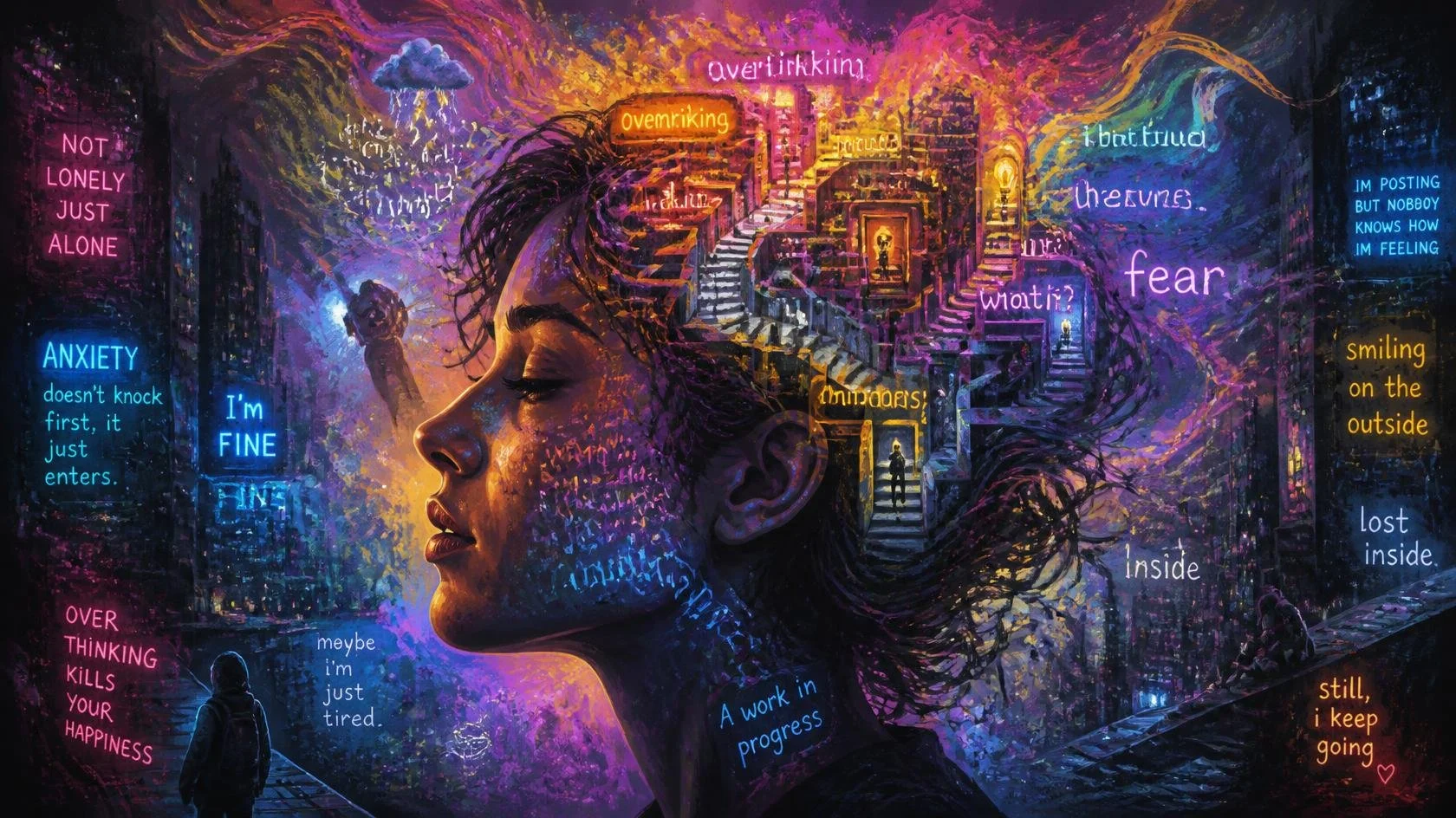
Mental Health Learning Path
Understand what’s happening within your mind and emotions.
Mental health affects how you think, feel, respond, function, connect, and move through everyday life. This Learning Path helps you better understand your mental and emotional experiences without reducing everything you're experiencing to a label.
Explore your thoughts, emotions, patterns, regulation, mental health conditions, everyday functioning, and the things that can support your well-being.
Begin Exploring ↓
🧭 What You'll Explore
The Mental Health Learning Path moves through eight areas:
Thoughts & Mental Patterns → understand what's happening in your mind
Emotions & Regulation → understand, experience, and work with your emotions
Anxiety → explore fear, worry, stress, and anxious patterns
Depression → understand depressive experiences and how they can affect daily life
ADHD & Executive Functioning → explore attention, regulation, motivation, organization, and executive functioning
OCD & Intrusive Thoughts → understand obsessions, compulsions, intrusive thoughts, and related patterns
Mood & Other Mental Health Conditions → explore different mental health experiences and conditions
Mental Wellness & Everyday Functioning → support your mental health in everyday life
Personalized Insights → Take what you're learning beyond general exploration and make it personal to you.
Thoughts & Mental Patterns
Understand what's happening inside your mind.
Thoughts are the ideas, interpretations, judgments, memories, expectations, and internal conversations that move through your mind. Mental patterns are recurring ways of thinking that can influence how you interpret yourself, other people, situations, and experiences.
Some patterns happen consciously, while others become so automatic that you may not realize they're shaping your reactions and decisions.
Exploring your thoughts and mental patterns can help you recognize what your mind repeatedly returns to, how you interpret experiences, and how those interpretations affect the way you feel and respond.
-
“Your mind can return to something even when thinking about it isn't helping anymore.”
Your mind naturally revisits experiences, problems, worries, and unanswered questions as it tries to understand them, solve them, or prepare for what might happen next. Sometimes this is useful. Other times, the same thoughts begin repeating without leading to anything new.
A mental loop can be fueled by uncertainty, stress, fear, unresolved emotions, or the feeling that you need to find the “right” answer before you can move on.
The more attention a thought receives, the more familiar that mental pathway can become—making it easier for your mind to return to it again.
Recognizing a repeating thought doesn't mean you have to force it away. It gives you an opportunity to ask: Is this thought helping me understand or solve something, or am I going over the same ground again?
-
“Something can feel true without being completely accurate.”
Your mind is constantly interpreting what's happening around you. Those interpretations are influenced by your experiences, emotions, expectations, fears, assumptions, and the information available to you at the time.
Because of this, having a thought doesn't automatically make that thought a fact. “They're upset with me,” “I'm going to fail,” or “Nobody understands me” may feel convincing without telling the entire story.
This doesn't mean you should distrust everything you think. It means learning to create a little space between having a thought and accepting it as truth.
Sometimes the most useful question isn't “Is this thought bad?” but “What do I actually know, and what am I assuming?”
Emotions & Regulation
Understand what you feel and how you respond to it.
Emotions are internal responses that provide information about what you're experiencing. They can be influenced by your thoughts, body, environment, relationships, memories, needs, and circumstances.
Emotional regulation is the ability to recognize, experience, manage, and respond to emotions in ways that allow you to continue functioning without needing to completely suppress what you feel.
Understanding your emotional world can help you recognize what you're feeling, what may be underneath it, and what you tend to do when emotions become intense.
-
“Your feelings are real, but they don't have to make every decision for you.”
Feeling an emotion and acting on that emotion are two different things. You can feel angry without yelling, feel afraid without immediately avoiding something, feel jealous without accusing someone, or feel hurt without shutting everyone out.
Emotions can give you information about what you're experiencing. They may signal that something feels threatening, important, unfair, disappointing, exciting, or meaningful to you. But the first impulse that comes with an emotion isn't always the response you ultimately want to choose.
Creating space between the feeling and the response allows you to acknowledge what you're experiencing while deciding what to do with it.
Emotional awareness isn't about ignoring what you feel. It's being able to say, “This is what I'm feeling—and I can choose how I respond to it.”
-
“Managing an emotion isn't the same as making yourself stop feeling it.”
Emotional regulation and emotional suppression can look similar from the outside, but they involve different processes.
Suppression involves pushing an emotion down, hiding it, or trying not to experience or express it. Regulation involves recognizing what you're feeling and finding ways to manage the intensity, expression, or response so the emotion doesn't completely take over what you do next.
Regulation might mean pausing before responding, calming your body, taking space, talking through what happened, or waiting until you're able to approach the situation more clearly.
The goal isn't to eliminate uncomfortable emotions. It's learning how to experience what you feel without either being controlled by it or pretending it isn't there.
Anxiety
Understand fear, worry, and the anticipation of what could happen.
Anxiety is a mental and physical response associated with fear, worry, uncertainty, or perceived threat. It can affect your thoughts, emotions, body, behavior, decisions, relationships, and ability to function.
Anxiety exists on a spectrum. It can be a temporary response to stressful circumstances or become persistent enough to significantly interfere with everyday life.
Understanding anxiety involves exploring not only what you're afraid of, but also how your mind and body respond when they believe something may be wrong or unsafe.
-
“They can feel similar, but they aren't exactly the same experience.”
Fear, stress, and anxiety can all activate your mind and body, but they generally arise in different ways.
Fear is a response to a perceived immediate threat or danger. Stress often develops in response to demands, pressure, challenges, or situations you feel you need to manage. Anxiety involves apprehension, nervousness, or worry and can continue even when there isn't an immediate threat in front of you.
They can also overlap. Stress about an upcoming situation may lead to anxiety about what could happen, while encountering something you perceive as threatening may trigger fear.
Learning to distinguish between them can help you ask a more useful question than simply “Why do I feel like this?” You can begin asking: Am I responding to danger, pressure, uncertainty—or some combination of them?
-
“What brings relief in the moment can sometimes keep the fear going.”
Anxiety can develop into a repeating cycle. Something triggers worry or fear, your mind begins anticipating what could go wrong, and your body may respond with physical sensations such as tension, a racing heart, restlessness, or feeling on edge.
To reduce that discomfort, you might avoid the situation, repeatedly seek reassurance, check for danger, or do something else that makes you feel safer. That relief can be very real—but it may also prevent you from learning that the feared outcome might not happen or that you may be able to handle the discomfort.
Over time, the mind can learn, “I felt better because I escaped, avoided, checked, or got reassurance,” making the same response more likely the next time anxiety appears.
Understanding the cycle isn't about blaming yourself for how you cope. It's about recognizing how trigger → anxiety → response → temporary relief can sometimes keep anxiety returning.
Depression
Understand what happens when heaviness reaches beyond an ordinary bad day.
Depression can involve persistent changes in mood, motivation, energy, interest, thinking, sleep, appetite, concentration, self-perception, and everyday functioning.
It doesn't always look like visible sadness. Someone may experience emptiness, numbness, exhaustion, irritability, withdrawal, loss of interest, hopelessness, or difficulty doing things that once felt manageable.
Understanding depression means recognizing that it can affect how someone feels, thinks, functions, connects, and experiences themselves and the world around them.
-
“Sometimes depression looks more like emptiness, exhaustion, or disconnection.”
Depression is often pictured as someone who feels visibly sad, but depressive experiences can show up in different ways. A person may feel empty, numb, irritable, disconnected, exhausted, hopeless, or less interested in things they normally enjoy.
Someone can also continue working, parenting, socializing, laughing, or completing daily responsibilities while struggling internally. What a person looks like from the outside doesn't always reflect what they're experiencing.
Depression can affect emotions, thoughts, motivation, energy, sleep, concentration, appetite, relationships, and everyday functioning—and people may experience different combinations of these changes.
Recognizing that depression can have different presentations helps move beyond the idea that someone must “look depressed” for their experience to deserve attention and support.
-
“A simple task can feel very different when your mind and body are already carrying more.”
During depression, everyday activities such as getting out of bed, showering, answering messages, preparing food, cleaning, concentrating, or starting a task can require much more effort than they normally would.
Depression can affect energy, motivation, concentration, decision-making, sleep, and interest or pleasure. When several of these are affected at once, even a task that seems small from the outside can feel unusually difficult to begin or complete.
This isn't the same as simply not wanting to do something. A person may genuinely want to function differently while struggling to access the energy or mental resources needed to do it.
Understanding this distinction can shift the question from “Why can't I just do it?” toward “What is making this harder right now, and what kind of support might help?”
ADHD & Executive Functioning
Understand attention, motivation, regulation, and getting things done.
ADHD is a neurodevelopmental condition that can affect attention, impulsivity, activity levels, motivation, emotional regulation, organization, time management, working memory, and other areas of daily functioning.
Executive functions are mental processes that help you plan, prioritize, begin tasks, shift attention, remember information, manage time, regulate responses, and follow something through to completion.
Exploring this area helps separate “I should just be able to do this” from understanding the processes involved in actually making it happen.
-
“Wanting to do something and being able to get yourself started aren't always the same thing.”
Executive functions are mental processes involved in things like starting tasks, organizing, planning, remembering information, managing time, shifting attention, and following through.
When executive functioning is difficult, a person may know exactly what needs to be done—and genuinely want to do it—but still struggle to begin, organize the steps, stay with the task, or complete it.
From the outside, this can sometimes be mistaken for laziness, lack of effort, or not caring. But difficulty with executive functioning isn't simply a matter of deciding to “try harder.”
Understanding the difference can shift the question from “Why won't I just do this?” to “What part of doing this is difficult for me, and what could make that part easier?”
-
“Difficulty regulating attention isn't the same as never being able to focus.”
ADHD doesn't always look like an inability to pay attention. Someone may struggle to focus on one task while becoming deeply absorbed in another, making their attention seem inconsistent or unpredictable.
Attention can be influenced by factors such as interest, novelty, urgency, stimulation, difficulty, and the environment. A task that immediately captures attention may therefore be much easier to engage with than one that feels repetitive, distant, or difficult to start.
This is one reason a person with ADHD may spend hours focused on something interesting while struggling to begin a task they know is important.
The inconsistency can be confusing, especially when it gets interpreted as “You can focus when you want to.” ADHD is better understood as involving difficulty regulating and directing attention, not simply having too little of it.
OCD & Intrusive Thoughts
Understand unwanted thoughts and the cycles that can form around them.
Intrusive thoughts are unwanted thoughts, images, impulses, or ideas that can appear unexpectedly and cause discomfort or distress. Having an intrusive thought does not automatically mean someone has OCD.
Obsessive-compulsive disorder involves patterns of obsessions and/or compulsions that can become distressing, time-consuming, or disruptive to everyday life.
Understanding this area can help distinguish between having an unwanted thought, becoming caught in a repetitive mental cycle, and experiencing patterns associated with OCD.
-
“A thought appearing in your mind isn't the same as choosing, believing, or wanting it.”
Intrusive thoughts are unwanted thoughts, images, urges, or ideas that can appear suddenly and feel disturbing, frightening, inappropriate, or completely inconsistent with what a person actually values.
Because the content can feel so upsetting, a person may begin asking, “Why would I think that?” “What if this means something about me?” or “What if I actually wanted it?” The distress can make the thought feel especially important.
But experiencing a thought isn't the same as agreeing with it, intending to act on it, or secretly wanting it to happen. People can have unwanted mental content precisely because the idea feels upsetting or conflicts with what matters to them.
Rather than judging someone's character by every thought that enters their mind, it helps to remember: a thought is something you experience—not automatically a reflection of who you are or what you intend to do.
-
“Temporary relief can unintentionally strengthen the need to repeat the cycle.”
In OCD, an obsession can involve an intrusive thought, image, urge, sensation, or doubt that creates significant distress or uncertainty. In response, a person may feel driven to perform a compulsion to reduce that distress or prevent something feared from happening.
Compulsions aren't always visible behaviors like checking, cleaning, or repeating an action. They can also happen mentally through reviewing memories, repeating phrases, analyzing thoughts, seeking certainty, or repeatedly trying to reassure yourself.
Completing the compulsion may temporarily reduce anxiety. But because relief follows the compulsion, the brain can learn to rely on that response again when the obsession returns.
The pattern can become obsession → distress → compulsion → temporary relief → obsession again. Understanding that cycle helps explain why OCD is more complex than simply having unusual thoughts or repetitive habits.
Mood & Other Mental Health Conditions
Understand the different ways mental health can affect a person's experience.
Mental health conditions are patterns of thoughts, emotions, behaviors, perceptions, or functioning that can cause significant distress or interfere with areas of someone's life.
Different conditions can affect people in very different ways, and even people with the same diagnosis may not have identical experiences.
This area creates room to explore mood conditions and other mental health experiences that extend beyond anxiety, depression, ADHD, and OCD without reducing the person experiencing them to a diagnosis.
-
“The same symptom can appear in more than one condition.”
Difficulty concentrating, changes in sleep, low energy, irritability, racing thoughts, avoidance, emotional shifts, or feeling disconnected aren't always connected to just one mental health condition.
Different conditions can share similar symptoms, and people can also experience more than one condition at the same time. Physical health, medications, substance use, stress, trauma, sleep, and major life circumstances can affect how someone feels and functions as well.
This is one reason identifying a mental health condition involves more than matching yourself to a list of symptoms. Professionals may consider which symptoms are present, how long they've been occurring, how they interact, and how they're affecting everyday life.
Recognizing yourself in a symptom can be useful for understanding your experience, but a symptom alone doesn't tell you its cause or establish a diagnosis.
-
“A diagnosis can describe a pattern without describing the whole person.”
A symptom is an individual experience or change, such as difficulty sleeping, low mood, excessive worry, or problems concentrating. A diagnosis is a clinical classification based on an established set of criteria and professional assessment.
Your lived experience is broader. It includes what those symptoms actually feel like for you, how they affect your relationships and daily life, what makes them better or worse, and the ways you've learned to function alongside them.
Two people with the same diagnosis may therefore experience it very differently. They may share certain clinical features while differing in severity, circumstances, challenges, strengths, and support needs.
A diagnosis can provide useful language and guide treatment or support, but it doesn't replace the individual story of how a person actually experiences their mental health.
Mental Wellness & Everyday Functioning
Support your mind in everyday life.
Mental wellness isn't simply the absence of a mental health condition. It includes the ways you care for and support your emotional, psychological, and everyday functioning.
Everyday functioning includes things such as sleeping, eating, completing responsibilities, maintaining relationships, managing stress, caring for yourself, resting, concentrating, creating routines, and asking for support when you need it.
This area focuses on understanding what helps you function, what makes functioning harder, and what supports your mental well-being over time.
-
“They can overlap, but they don't describe exactly the same experience.”
Stress is a response to demands, pressure, or challenges that require something from you. In manageable amounts, stress can be temporary and may ease once the situation changes or the demand passes.
Overwhelm can happen when what you're carrying feels greater than your current ability or capacity to manage it. You may feel mentally overloaded, emotionally flooded, scattered, frozen, or unsure where to begin.
Burnout develops through prolonged or repeated stress, particularly when demands continue without enough recovery, resources, or support. It can involve exhaustion, reduced effectiveness, and increasing mental or emotional distance from what you've been doing.
These experiences can feed into one another, but distinguishing them can help you recognize whether you need to manage a current stressor, reduce what's overwhelming your capacity, or address a longer-term pattern of depletion.
-
“Support doesn't have to come from one person—or look the same for every need.”
A support system can include friends, family, partners, community members, support groups, healthcare providers, mental health professionals, or other people and resources you can turn to when you need help.
Different people may also provide different kinds of support. One person may be someone you talk to when you're struggling, while another helps with practical responsibilities, offers companionship, shares useful resources, or connects you with professional care.
Having support doesn't mean someone else has to solve everything for you. It means you don't have to rely entirely on yourself for every emotional, practical, or mental health need.
A useful support system isn't necessarily about how many people you have around you. It's about whether you have safe, appropriate places to turn for the different kinds of support you may need.
PERSONALIZED INSIGHTS
Explore What's Happening Within You
Understanding mental health can also bring questions about your own emotions, patterns, responses, and experiences.
Use Personal Insights to explore recurring personal patterns, better understand yourself, or receive one-on-one support for what you're currently navigating.
-
Explore recurring emotional patterns, protective responses, wounds, family influences, challenges, and areas of personal growth.
-
Explore the bigger picture of who you are, including your emotional nature, strengths, challenges, personal patterns, and the different parts of yourself that work together.
-
Talk through what you're experiencing and explore the patterns, circumstances, or questions surrounding it from different perspectives.
-
Need somewhere to talk? Receive private one-on-one support to vent, process what you're experiencing, gain perspective, or simply be heard.
Continue Your Journey
🔍 Self-Discovery → understand yourself, your identity, values, strengths, and patterns more deeply.
🖤 Healing → explore wounds, trauma, triggers, inner-child experiences, and patterns beneath the surface.
❤️ Love & Relationships → explore how mental and emotional patterns can affect connection and relationships.
🌱 Purpose & Direction → explore direction, transitions, goals, and moving forward when you're trying to determine what's next.