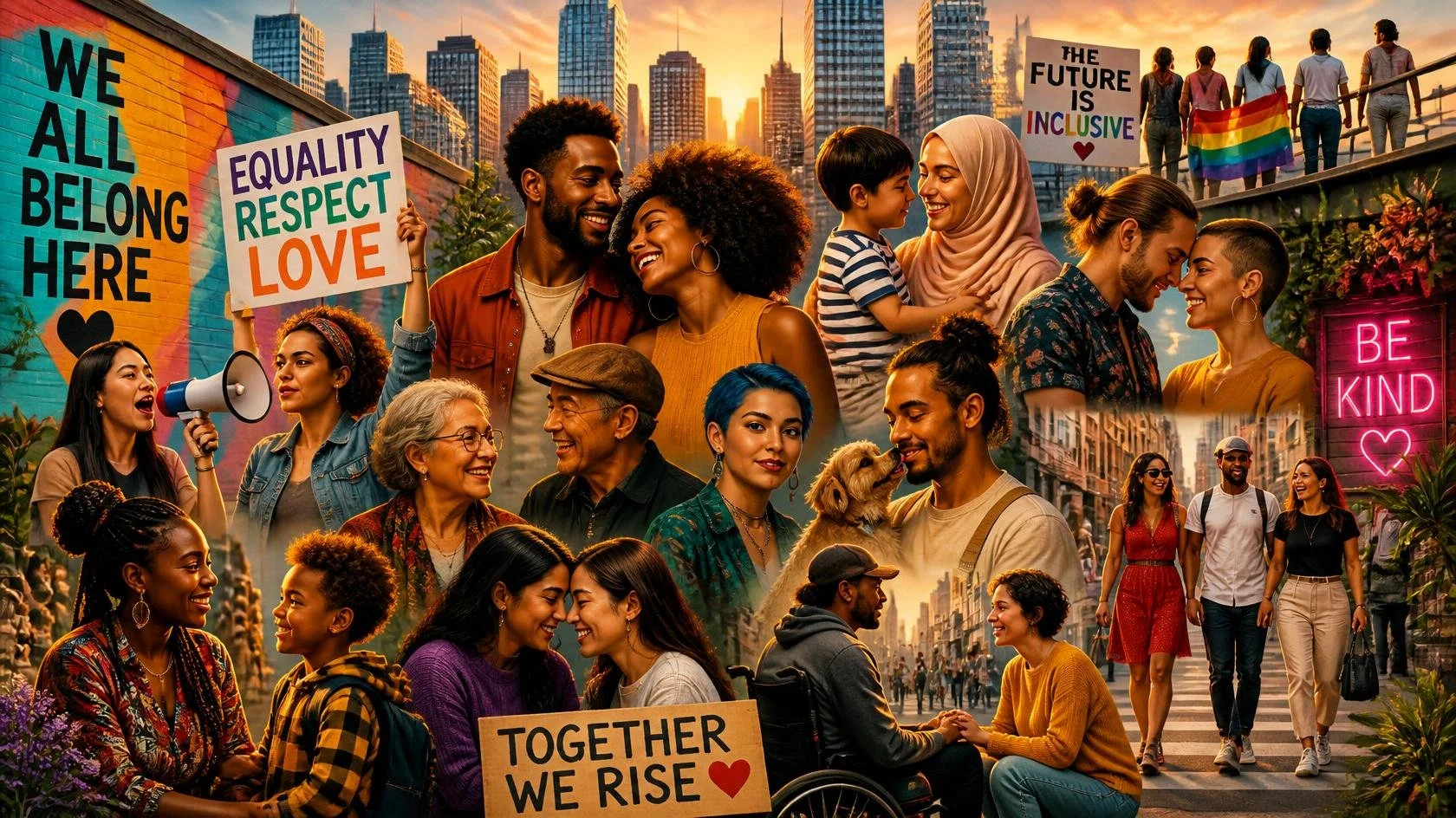
Society, Gender & Human Relationships
Investigating how people relate to one another—and how society shapes those relationships.
Human behavior doesn't happen in isolation.
We live within relationships, communities, cultures, institutions, economic systems, social expectations, and structures that influence what opportunities we have, what behaviors are rewarded or punished, how different groups are treated, and what we come to believe is normal.
At the same time, individuals and groups continuously influence the societies they live within.
This research area investigates relationships between people, patterns between groups, gender, power, inequality, culture, crime, social institutions, and collective human behavior.
The question isn't only:
“What are people doing?”
It's also:
“What conditions, relationships, and systems are shaping what we're seeing?”
Explore the Research ↓
🧭 What You'll Investigate
Society, Gender & Human Relationships explores eight areas:
👩🏽🤝👨🏽 Gender & Social Expectations → gender roles, expectations, stereotypes, socialization, differences, and how gender influences people's experiences
❤️ Relationships & Intimate Partnerships → dating, partnership, marriage, relationship patterns, conflict, commitment, separation, and changing relationship norms
⚖️ Power, Inequality & Social Hierarchies → how power, status, resources, opportunity, discrimination, and inequality are distributed and maintained
🌍 Culture, Norms & Social Change → how cultures develop shared beliefs and expectations and how those norms change across generations
🏛️ Institutions, Systems & Everyday Life → how education, work, law, media, family, economics, and other institutions influence people's lives
⚠️ Crime, Violence & Social Harm → patterns in crime, violence, victimization, offending, prevention, and the social conditions surrounding harm
📱 Media, Technology & Collective Behavior → how traditional media, social media, technology, algorithms, online communities, and information environments influence people and groups
🤝 Division, Cooperation & Social Connection → conflict between groups, polarization, prejudice, belonging, empathy, cooperation, community, and what brings people together or pushes them apart
Gender & Social Expectations
How does gender shape the way people experience society?
Gender can influence expectations around behavior, appearance, relationships, caregiving, work, emotion, sexuality, leadership, strength, vulnerability, responsibility, and family life.
Some differences observed between women and men may relate to biology. Others may be influenced by culture, socialization, environment, opportunity, expectations, or an interaction between multiple factors.
These patterns can also differ across cultures, generations, socioeconomic conditions, and other populations.
This area investigates gender differences, gender roles, social expectations, stereotypes, socialization, changing norms, and how gender relates to people's experiences and outcomes.
-
Where do expectations about how women and men “should” behave come from?
A gender role is a set of social expectations associated with being perceived as a particular gender within a society or culture.
Gender roles can influence expectations involving appearance, behavior, emotions, relationships, parenting, work, leadership, caregiving, sexuality, and responsibilities within families and communities.
These expectations are not identical across every society or historical period.
What is considered appropriately “masculine” or “feminine” can vary across cultures and can change substantially over time.
Individuals also do not necessarily behave according to the gender roles surrounding them.
What the Evidence Suggests
Gender roles are influenced by social and cultural environments and can be reinforced through families, peers, institutions, media, and broader social expectations.
What Remains Important
Recognizing social influence does not automatically answer every question about differences between women and men. Biological, developmental, cultural, and social factors may interact depending on what difference is being investigated.
TRI Question: When women and men behave differently, how can researchers determine what reflects biology, social expectations, individual choice—or an interaction among them?
-
How do children learn what their culture expects from girls and boys?
Gender socialization refers to processes through which children learn gender-related expectations, behaviors, roles, and norms within their social environment.
This learning can occur both directly and indirectly.
Adults may explicitly communicate expectations about clothing, activities, emotions, responsibilities, or behavior.
Children can also observe patterns around them: who performs certain household tasks, which toys are marketed to whom, how characters are portrayed in media, how peers behave, and which behaviors receive approval or criticism.
Children themselves are active participants in this process and may imitate, question, accept, resist, or reinterpret the expectations they encounter.
What the Evidence Suggests
Families, peers, schools, media, culture, and other social environments can all contribute to children's developing ideas about gender.
What Remains Important
Socialization does not mean every gender difference is created entirely by society, nor does exposure to an expectation guarantee a child will adopt it.
TRI Question: How can researchers separate what children learn about gender from their environment from differences that may emerge through other developmental or biological processes?
Relationships & Intimate Partnerships
Why do human relationships take the forms they do?
Relationships are influenced by far more than attraction.
Expectations around dating, commitment, marriage, sex, fidelity, household responsibilities, finances, parenting, communication, separation, and partnership have changed across cultures and throughout history.
Individual psychology interacts with these broader expectations.
This area investigates dating patterns, partnership, marriage, relationship roles, conflict, commitment, separation, relationship satisfaction, changing norms, and patterns between intimate partners.
-
Has the way people meet, choose, and build relationships always looked like it does today?
Dating norms are the social expectations surrounding how people meet potential partners, express interest, form relationships, and decide whether to continue them.
These norms can change across generations and cultures.
Dating has been influenced by changing expectations around marriage, gender roles, sexuality, education, work, independence, and technology.
The rise of online dating and social media has also expanded the ways people can meet and communicate with potential partners.
As norms change, expectations about who initiates, when commitment happens, and what a relationship should provide can change with them.
What the Evidence Suggests
Dating behavior does not exist separately from society. Relationship formation changes alongside broader cultural, technological, and economic conditions.
What Remains Important
There has never been one universal dating experience. Age, culture, community, sexual orientation, socioeconomic conditions, and personal values can produce very different patterns.
TRI Question: When dating feels different from previous generations, which changes come from technology—and which reflect larger changes in society?
-
Why do some people feel fulfilled in their relationships while others become increasingly dissatisfied?
Relationship satisfaction generally refers to how positively people evaluate the quality of their intimate relationship.
Researchers study many factors that may relate to satisfaction, including communication, conflict, intimacy, commitment, perceived partner responsiveness, stress, expectations, and how partners support one another.
Satisfaction is also not necessarily constant.
Relationships exist within real-life circumstances, so financial pressure, parenting, health, work, major transitions, and other stressors may affect how partners experience the relationship.
What the Evidence Suggests
Relationship satisfaction appears to reflect multiple interacting factors rather than one universal ingredient that guarantees a successful partnership.
The way partners respond to each other and manage difficulties can matter alongside individual and environmental factors.
What Remains Important
Satisfaction and stability are not identical. A relationship can remain intact despite low satisfaction, while ending a relationship does not by itself prove the relationship was unsuccessful.
TRI Question: What matters most for relationship satisfaction—the people involved, the way they interact, or the circumstances surrounding the relationship?
Power, Inequality & Social Hierarchies
Who has access to power, resources, protection, and opportunity?
Societies distribute resources and influence unevenly.
Income, wealth, education, employment, political influence, social status, legal protection, housing, healthcare, and other opportunities can vary considerably between populations.
Differences in outcomes do not automatically reveal their cause.
Understanding them requires examining history, institutions, individual behavior, policies, discrimination, economic conditions, geography, culture, opportunity, and other possible contributing factors.
This area investigates power, inequality, privilege, disadvantage, discrimination, social mobility, resource distribution, and social hierarchies.
-
Why are resources, opportunities, and outcomes distributed differently across groups within a society?
Social inequality refers to unequal access to resources, opportunities, status, power, or social advantages within a society.
Researchers may examine inequality in areas such as income, wealth, education, employment, housing, healthcare, political influence, and exposure to environmental or social risks.
Not every difference between individuals or groups is automatically evidence of unfair treatment.
Research into inequality asks how a difference developed, which factors contribute to it, whether barriers exist, and how consistently the pattern appears.
What the Evidence Suggests
Social outcomes can be influenced by both individual characteristics and larger conditions such as family resources, institutions, neighborhoods, policies, discrimination, and economic structures.
These factors can also interact.
What Remains Important
Finding a statistical inequality does not, by itself, establish its cause. Explaining disparities often requires examining multiple competing or interacting explanations.
TRI Question: When two groups experience different outcomes, what evidence is needed to determine why the difference exists?
-
How much can a person's social or economic position change during their lifetime—or from one generation to the next?
Social mobility refers to movement within a society's social or economic structure.
Researchers may study intragenerational mobility, which examines changes during one person's lifetime, or intergenerational mobility, which compares outcomes between generations, such as children and their parents.
Mobility can involve income, wealth, education, occupation, or broader socioeconomic status.
A society can have economic inequality while still having some mobility, so the two concepts are related but not identical.
What the Evidence Suggests
Mobility is influenced by more than individual effort alone. Family circumstances, education, neighborhoods, labor markets, economic conditions, policies, and access to opportunities can all matter.
What Remains Important
How much mobility exists depends partly on what is being measured and across what time period or population.
Moving upward is possible without everyone having the same likelihood of doing so.
TRI Question: How much does where someone begins in society influence where they are realistically able to end up?
Culture, Norms & Social Change
Who decides what a society considers normal?
Cultures develop shared ideas about acceptable behavior, relationships, family, success, morality, appearance, gender, work, religion, sexuality, responsibility, and community.
Those expectations can feel natural simply because people grow up surrounded by them.
But social norms change.
Ideas considered ordinary in one generation, culture, or community may be rejected in another.
This area investigates cultural norms, values, traditions, social expectations, generational differences, cultural change, social movements, and how societies redefine what they consider acceptable.
-
How do people learn the unwritten rules of what their society considers normal or acceptable?
A social norm is a shared expectation about how people are supposed to behave within a particular group, community, or society.
Some norms are explicit, but many operate as unwritten rules.
They can influence clothing, manners, relationships, family roles, communication, work, public behavior, and ideas about what is appropriate or inappropriate.
People can learn norms through observation, social feedback, institutions, family, peers, media, traditions, and everyday interaction.
Norms can also vary considerably between cultures, communities, and historical periods.
What the Evidence Suggests
Human behavior is influenced not only by personal beliefs and formal laws but also by perceptions of what other people commonly do and approve of.
What Remains Important
A behavior being socially accepted does not necessarily make it beneficial, ethical, or universal.
Social norms can also be challenged and changed.
TRI Question: How much of what people consider “normal” reflects human nature—and how much reflects the society they happened to grow up in?
-
How does something considered normal in one generation become questioned—or even unacceptable—in another?
Cultural change occurs when shared beliefs, values, behaviors, practices, or social expectations shift over time.
Change can emerge through many pathways.
Technology can introduce new ways of living. Economic conditions can alter family and work patterns. Migration can bring cultures into greater contact. Social movements may challenge established norms, while laws and institutions can reinforce or disrupt existing practices.
Generational replacement can also contribute as people raised under different circumstances bring different experiences and expectations into society.
What the Evidence Suggests
Culture is not fixed. Social norms and values can change through interactions among individuals, groups, institutions, technology, economic conditions, and historical events.
What Remains Important
Cultural change rarely happens evenly. Different communities may adopt, resist, or reinterpret the same change at different rates.
TRI Question: What causes a society to move from simply questioning an established norm to replacing it with a new one?
Institutions, Systems & Everyday Life
How do larger systems shape individual lives?
People interact with institutions throughout their lives.
Families, schools, workplaces, governments, courts, healthcare systems, religious institutions, economic systems, and media organizations can all influence opportunities, expectations, resources, and behavior.
Institutions are created and operated by people, but they can also develop rules and structures that continue beyond any one individual.
This area investigates how institutions operate, who they affect, how their outcomes differ across populations, and how institutional structures influence everyday life.
-
How do the systems surrounding us shape everyday life?
A social institution is an established system of roles, rules, practices, and relationships organized around important parts of society.
Common examples include family, education, government, law, religion, healthcare, media, and the economy.
Institutions help organize how societies function. They can influence what people learn, how resources are distributed, which behaviors are encouraged or restricted, and what opportunities are available.
People also interact with multiple institutions at the same time.
A family's experiences, for example, may be affected by schools, workplaces, healthcare systems, housing markets, laws, and economic conditions.
What the Evidence Suggests
Individual lives are shaped not only by personal choices and relationships but also by the larger systems within which those choices are made.
What Remains Important
Institutions are not fixed. Their policies, practices, accessibility, and effects can change over time and differ across populations.
TRI Question: How much of what happens in an individual's life reflects personal choices—and how much reflects the institutions surrounding those choices?
-
How much can someone's educational experience influence what happens later in life?
Education can influence life through more than the knowledge learned in a classroom.
Researchers examine relationships between education and outcomes involving employment, earnings, health, social networks, civic participation, and access to future opportunities.
Schools can also provide resources, relationships, credentials, and environments that differ substantially between communities.
But people who receive different levels or types of education may also differ in family resources, neighborhoods, health, prior opportunities, and other characteristics.
That makes cause and correlation important to distinguish.
What the Evidence Suggests
Educational attainment is associated with many later-life outcomes, but education operates within a much larger social and economic environment.
What Remains Important
Simply observing that people with more education have different outcomes does not prove education alone produced the difference.
Researchers must examine what other factors contribute.
TRI Question: How much does education itself change a person's future—and how much does education reflect opportunities and advantages that were already present?
Crime, Violence & Social Harm
What can patterns of harm tell us about a society?
Crime and violence are not distributed evenly across every population, location, age group, circumstance, or type of offense.
Studying those differences requires more than looking at a single percentage.
Researchers may examine offending, victimization, age, gender, socioeconomic conditions, relationships between victim and offender, location, opportunity, substance use, policing, reporting practices, social conditions, and other factors.
This area investigates crime rates, offending patterns, victimization, violence, domestic and family violence, homicide, sexual violence, child harm, prevention, and the conditions associated with different forms of social harm.
-
When we hear that a certain crime is rising or falling, where does that number actually come from?
Crime statistics are produced using several different sources of information rather than one complete record of every crime that occurs.
One major source is law-enforcement data, which records crimes reported to or identified by police.
Researchers can also use victimization surveys, which ask people about crimes they experienced whether or not those incidents were reported to law enforcement.
Other sources may include court records, correctional data, hospital records, specialized surveys, and research studies.
Each source measures something slightly different.
What the Evidence Suggests
Crime data can reveal important patterns involving offending, victimization, location, age, sex, and changes over time.
But the numbers depend partly on how crime is defined, detected, reported, recorded, and measured.
What Remains Important
No single crime dataset captures every offense that occurs.
Comparisons also require attention to definitions, populations, time periods, and changes in data-collection practices.
TRI Question: When different sources produce different estimates of crime, which number comes closest to what is actually happening?
-
Does the number of crimes recorded by authorities equal the number of crimes that actually occurred?
Not every crime that occurs becomes part of official police statistics.
Some victims report what happened. Others do not.
Reasons for not reporting can include fear, shame, distrust of authorities, concern about retaliation, believing the incident is too minor, relationships with the person responsible, or uncertainty about whether authorities can help.
Some offenses may also occur without a victim recognizing or identifying them as crimes.
The difference between crimes that occur and crimes known to authorities is sometimes described as the “dark figure of crime.”
What the Evidence Suggests
Official crime statistics measure recorded crime, not every crime that occurs within a population.
Victimization surveys and other research methods can help estimate some of what official records miss.
What Remains Important
Unreported crime cannot be measured perfectly either. Surveys depend on memory, willingness to disclose, sampling, definitions, and question wording.
TRI Question: If neither police records nor surveys capture every crime, how accurately can researchers estimate the true level of crime in society?
Media, Technology & Collective Behavior
What happens when millions of people influence one another at once?
Technology has changed how people communicate, form relationships, receive information, organize communities, argue, learn, compare themselves, and participate in society.
Online environments can spread information rapidly—but they can also amplify misinformation, outrage, social comparison, conflict, and highly emotional content.
Algorithms and platform design can influence what people repeatedly encounter.
This area investigates social media, online communities, algorithms, misinformation, digital culture, media influence, virality, echo chambers, social comparison, and technology's effects on collective behavior.
-
Why do different people see completely different content on the same platform?
An algorithmic recommendation system is a system that selects, ranks, or suggests content based on information intended to predict what a user may find relevant or engaging.
These systems can use signals such as previous clicks, watch time, searches, likes, shares, follows, purchases, or interactions with similar content.
This means two people using the same platform may encounter very different information environments.
Recommendation systems don't necessarily determine what someone believes, but they can influence which information receives attention and how often someone encounters it.
What the Evidence Suggests
Algorithms can shape exposure by making some content more visible while making other content less likely to appear.
Users also influence recommendations through their own behavior, creating an ongoing interaction between the person and the system.
What Remains Important
An algorithm showing someone particular content does not prove that content changed their beliefs or behavior.
Exposure, engagement, persuasion, and behavioral change are different questions.
TRI Question: If algorithms increasingly determine what information reaches us, how much are we choosing what we see—and how much is being chosen for us?
-
Is every piece of false information intentionally deceptive?
Misinformation generally refers to false or inaccurate information that is shared regardless of whether the person spreading it intends to deceive.
Someone can sincerely believe incorrect information and pass it to others.
Disinformation, by contrast, generally involves false or misleading information deliberately created or distributed to deceive.
The distinction is primarily about intent.
That intent can sometimes be difficult to establish from the information itself.
A false claim may also move through different stages: something intentionally created to mislead can later be shared by people who genuinely believe it is true.
What the Evidence Suggests
False information can spread through both deliberate manipulation and ordinary social sharing.
Repetition, emotional content, familiarity, social networks, and information environments can all affect how widely claims circulate.
What Remains Important
Information isn't misinformation simply because it is disputed, unpopular, or later revised. Determining whether a factual claim is false requires evidence.
Determining whether it is disinformation additionally requires evidence about intent.
TRI Question: When false information spreads across thousands of people, how can researchers distinguish deliberate deception from people unknowingly repeating something they believe?
Division, Cooperation & Social Connection
Why do humans divide into groups—and what helps those groups cooperate?
Humans form identities around families, communities, cultures, nations, beliefs, interests, experiences, and social groups.
Group belonging can create support, identity, cooperation, and community.
It can also contribute to stereotyping, prejudice, hostility, competition, exclusion, and an “us versus them” mentality.
This area investigates group identity, prejudice, polarization, social conflict, empathy, cooperation, community, belonging, reconciliation, and the conditions that increase either division or connection.
-
Why do humans sometimes favor people they see as part of “us”?
An in-group is a group someone identifies with or experiences as belonging to.
In-group bias refers to a tendency to evaluate, favor, trust, or treat members of one's own group more positively than people outside that group.
Groups can form around nationality, community, religion, gender, interests, organizations, social identities, or even relatively arbitrary categories.
Research has found that simply categorizing people into groups can sometimes be enough to produce preferential treatment toward one's own group.
What the Evidence Suggests
Group membership can influence judgment and behavior, even when people are not consciously attempting to discriminate.
However, identifying with a group does not automatically produce hostility toward outsiders.
What Remains Important
In-group favoritism and out-group hostility are not the same thing. People can prefer or support their own group without necessarily wanting to harm another.
Context, competition, perceived threat, social norms, and group identity can influence what happens next.
TRI Question: What turns ordinary group belonging into an “us versus them” mentality?
-
What makes someone feel that they are genuinely accepted and included among other people?
Belonging generally refers to the experience of feeling accepted, included, valued, and connected within relationships or groups.
Humans form connections through families, friendships, communities, schools, workplaces, cultures, organizations, and shared identities or experiences.
But simply being physically present in a group does not guarantee someone will feel that they belong.
Acceptance, meaningful interaction, mutual support, shared experiences, recognition, and feeling able to participate without persistent rejection can all contribute to belonging.
What the Evidence Suggests
Social connection and belonging are important parts of human experience and can be associated with psychological and social well-being.
Belonging can also influence how strongly people identify with groups and communities.
What Remains Important
Belonging can have both constructive and harmful expressions. Strong group connection can provide support and cooperation, while some groups may demand conformity or define belonging through exclusion of outsiders.
TRI Question: What allows people to experience strong belonging without requiring someone else to become the outsider?
Investigations
This is where TRI examines specific social questions, claims, and patterns.
Investigations may begin with questions such as:
Why do crime rates differ between women and men?
How have expectations of women and men changed over time?
Why are some forms of violence more common than others?
How does social media contribute to conflict between groups?
How are power and resources distributed across different populations?
Why do societies become increasingly polarized?
How do economic conditions affect relationships and families?
What actually reduces crime and violence?
An investigation may examine population data, research studies, historical context, demographic differences, policies, competing explanations, reporting limitations, and changes over time.
When gender, race, age, class, or another demographic is involved, TRI should avoid treating one statistic as the whole story. The investigation can look at the overall pattern and then the factors underneath it.
Continue Investigating
🧠 Mind, Psychology & Human Behavior → investigate the individual psychological processes behind behavior
🧬 Human Development & Family Systems → investigate how development, parenting, family environments, and generational patterns shape people
🧠 Consciousness & Human Potential → investigate cognition, awareness, perception, and human capabilities
🚪 Beyond The Research Institute
🎓 The Divine Academy → when a social or relationship question becomes an exploration of your own relationships, patterns, identity, mental health, or healing
✨ Promise of Light → when a social issue becomes specifically about children, parenting, development, safety, advocacy, or family life