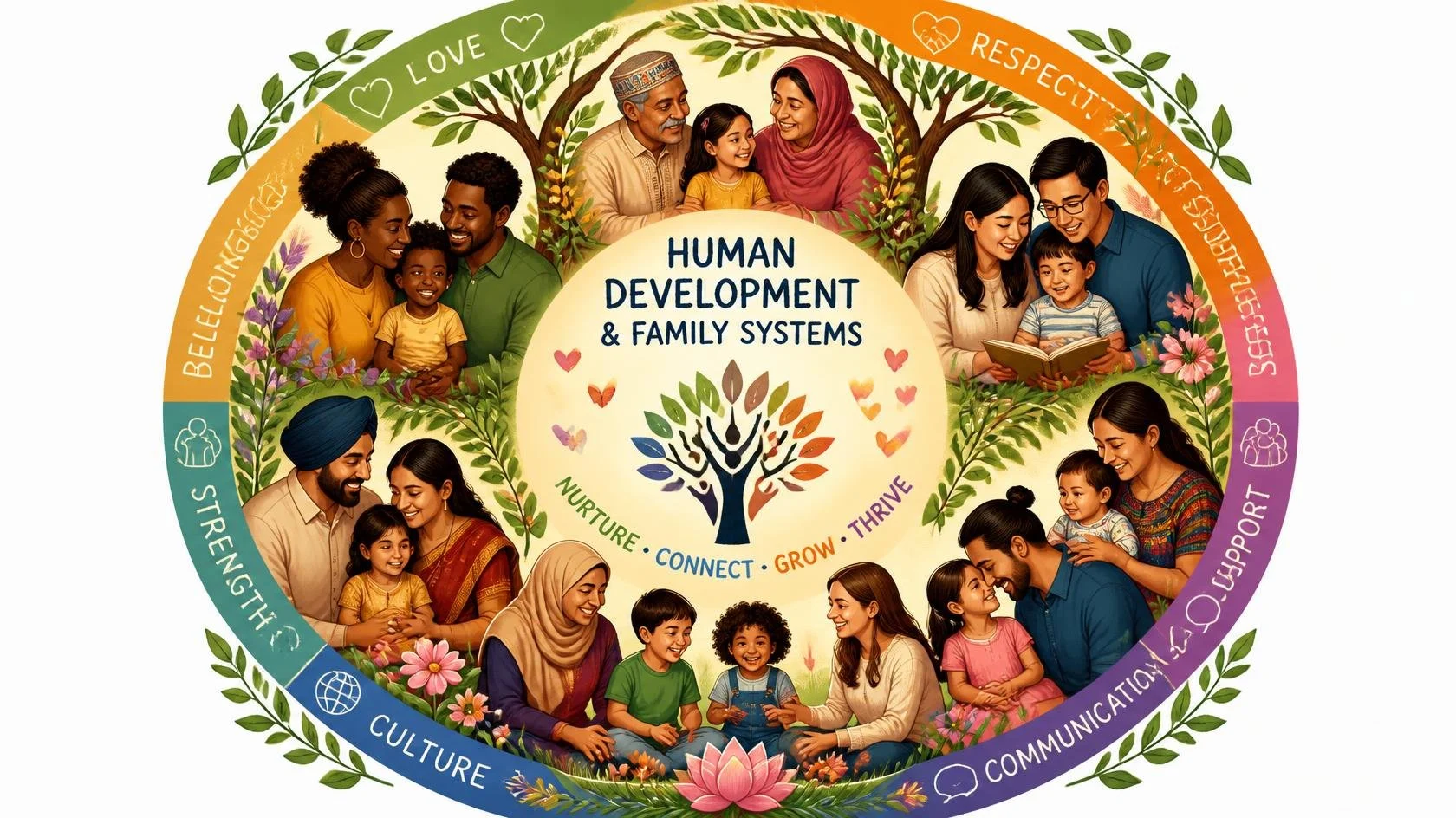
Human Development & Family Systems
Investigating how people develop—and how families, relationships, and environments shape that development.
Human beings change throughout life.
Biology matters. So do caregivers, relationships, family environments, culture, education, opportunities, adversity, social conditions, and individual experiences.
Development also doesn't happen in isolation. People grow within systems, and what happens within a family can influence everyone inside it.
This research area investigates how humans develop across the lifespan, how early experiences can influence later outcomes, and how family systems shape the people within them.
The question isn't simply:
“What happened to this person?”
It's also:
“What helped shape who they became?”
Explore the Research ↓
🧭 What You'll Investigate
Human Development & Family Systems explores eight areas:
🌱 Human Development Across the Lifespan → how people physically, cognitively, emotionally, and socially develop from infancy through later adulthood
🧠 Childhood Development & Learning → how children develop language, thinking, emotional skills, behavior, social understanding, and the ability to learn
🤝 Attachment, Caregiving & Early Relationships → how early relationships and caregiving experiences may influence attachment, security, regulation, and later relationships
👨👩👧 Parenting, Discipline & Socialization → how parenting practices, discipline, expectations, modeling, and socialization influence development
🏡 Family Systems, Roles & Dynamics → how relationships, roles, communication, conflict, power, responsibilities, and patterns operate within families
🌿 Adolescence, Identity & Independence → how puberty, identity development, peers, family relationships, risk-taking, autonomy, and transition shape adolescence
🖤 Adversity, Resilience & Developmental Outcomes → how trauma, instability, loss, stress, neglect, violence, poverty, support, and protective factors can influence development
🧬 Generational Patterns, Culture & Environment → how beliefs, behaviors, traditions, social conditions, culture, family history, and environments can influence people across generations
Human Development Across the Lifespan
How do humans change throughout life?
Development doesn't stop when childhood ends.
People continue changing physically, cognitively, emotionally, socially, and psychologically throughout adolescence, adulthood, and later life.
Some changes follow common developmental patterns. Others vary considerably between individuals.
Biology, health, relationships, education, environment, opportunity, culture, experiences, and life events can all influence development.
This area investigates developmental stages, milestones, individual differences, aging, transitions, and the factors that influence human development across the lifespan.
-
How do humans change from infancy through the later years of life?
Human development is the study of how people change across the lifespan.
Development occurs across several interconnected areas, including physical growth, brain and cognitive development, language, emotional development, relationships, identity, and social functioning.
Although childhood involves rapid development, development does not stop when someone becomes an adult.
People continue changing throughout adolescence, adulthood, and later life as biology, relationships, experiences, environments, and life circumstances interact.
Development also isn't perfectly linear. A person can make significant progress in one area while experiencing challenges or slower change in another.
What the Evidence Suggests
Human development is a lifelong process influenced by both biological and environmental factors.
What Remains Important
Developmental patterns can help researchers understand common changes across populations, but they don't create one universal timeline that every individual must follow.
TRI Question: If development continues throughout life, how much of who we become is established early—and how much remains open to change?
-
Does the human brain really become “fully developed” at age 25?
The claim that the brain finishes developing at exactly 25 years old is an oversimplification.
Research shows that brain development continues through adolescence and into young adulthood, including changes in networks involved in planning, decision-making, impulse control, and evaluating consequences.
But there isn't one birthday when the entire brain suddenly becomes complete.
Different brain regions and functions follow different developmental trajectories, and researchers continue studying changes that occur beyond young adulthood.
The brain also retains the capacity to change through neuroplasticity throughout life.
What the Evidence Suggests
The twenties are an important period of continued brain maturation, but “the brain finishes developing at 25” should not be treated as a precise biological cutoff.
What Remains Important
Brain development and a person's maturity are not interchangeable. Age alone cannot tell us exactly how responsible, capable, or emotionally mature an individual will be.
TRI Question: If there is no single moment when the brain becomes “finished,” why did age 25 become such a widely repeated developmental claim?
Childhood Development & Learning
How does a child gradually learn to understand themselves and the world?
Children aren't simply smaller adults.
Their brains, bodies, language, reasoning, emotional abilities, social understanding, and behavioral control develop over time.
Children learn through observation, interaction, repetition, play, instruction, exploration, relationships, consequences, and their environments.
Development also varies. Children may reach abilities at different times or develop unevenly across different areas.
This area investigates cognitive, emotional, social, language, behavioral, and learning development during childhood.
-
What actually happens as children begin understanding themselves and the world around them?
Children learn through multiple interacting processes rather than through one single method.
They learn by observing, exploring, practicing, playing, communicating, receiving feedback, solving problems, and interacting with other people and their environments.
Some learning happens intentionally, such as when someone directly teaches a child a new skill.
Other learning happens through everyday experience. Children can learn language by interacting with others, social behavior by observing people around them, and physical skills through repeated practice.
Age and development also affect what children are ready to understand and do.
What the Evidence Suggests
Learning involves interactions between brain development, experience, attention, memory, motivation, relationships, and environment.
No single learning method works equally well for every skill, situation, or child.
What Remains Important
Children may need different amounts of time, repetition, instruction, practice, or support to learn the same skill.
TRI Question: If children learn through many different processes, what determines which experiences become lasting knowledge and skills?
-
What allows a child to pause, remember what they're supposed to do, and work toward a goal?
Executive function refers to a group of mental processes involved in managing thoughts, attention, behavior, and actions toward a goal.
These processes commonly include working memory, inhibitory control, and cognitive flexibility.
Working memory helps hold and use information temporarily.
Inhibitory control helps manage impulses and resist automatic responses.
Cognitive flexibility helps shift attention, adjust to changing demands, and approach something in a different way.
These abilities develop gradually throughout childhood and adolescence rather than appearing fully formed at once.
What the Evidence Suggests
Executive-function skills are important for learning, planning, following instructions, solving problems, regulating behavior, and completing tasks.
What Remains Important
Difficulty with executive function shouldn't automatically be interpreted as laziness, defiance, or lack of intelligence. Development, environment, stress, sleep, and individual differences can affect performance.
TRI Question: How much of what adults call “self-control” actually depends on cognitive abilities that are still developing?
Attachment, Caregiving & Early Relationships
How can early relationships influence development?
From infancy onward, children depend on other people for protection, comfort, regulation, interaction, and care.
Repeated experiences with caregivers can contribute to expectations about whether other people are available, responsive, predictable, or safe.
Attachment research examines these early relationship patterns and their possible influence on emotional regulation, exploration, trust, and later relationships.
Early experiences can matter without permanently determining someone's future.
This area investigates attachment, caregiving, bonding, responsiveness, separation, security, early relationships, and their potential developmental effects.
-
Why do early relationships with caregivers matter in human development?
Attachment theory is a psychological framework examining the emotional bonds children develop with caregivers and how those relationships relate to feelings of safety, security, and exploration.
The theory is strongly associated with psychologist John Bowlby, with later research by Mary Ainsworth helping researchers study differences in children's attachment behavior.
Attachment isn't simply about how much a caregiver loves a child.
Researchers examine patterns involving how children seek comfort, respond to separation and reunion, explore when a caregiver is available, and use trusted caregivers as a source of security.
What the Evidence Suggests
Early caregiving relationships can play an important role in emotional and social development.
Consistent, responsive caregiving is generally associated with greater attachment security.
What Remains Important
Attachment theory doesn't mean one relationship determines a person's entire future. Children can form attachments with multiple caregivers, and development continues as relationships and environments change.
TRI Question: How much influence do our earliest relationships actually have on the relationships we form later?
-
If someone develops an attachment pattern early, are they stuck with it forever?
Attachment is sometimes discussed as though every person receives one permanent attachment style during childhood.
Research presents a more complicated picture.
Early attachment patterns can show some continuity over time, but they are not necessarily fixed for life.
Later relationships, caregiving changes, stressful experiences, supportive environments, therapy, and significant life events may all contribute to changes in how people experience closeness, security, trust, and dependence.
Attachment can also vary across different relationships.
What the Evidence Suggests
Early attachment experiences matter, but attachment patterns can show both stability and change across development.
Childhood does not create an unchangeable relationship destiny.
What Remains Important
Popular attachment categories can simplify a much larger research field. Adult attachment measures are also not identical to the methods used to study attachment between infants and caregivers.
TRI Question: If attachment can change through later relationships and experiences, what makes some early patterns persist while others are revised?
Parenting, Discipline & Socialization
How do adults teach children how to function within their world?
Children learn more from caregivers than rules.
They observe how adults communicate, respond to emotion, handle conflict, establish boundaries, express affection, manage stress, solve problems, and interact with other people.
Parenting practices and discipline can also differ significantly across families, cultures, generations, and circumstances.
This area investigates parenting approaches, discipline, reinforcement, modeling, expectations, supervision, socialization, caregiver behavior, and their associations with developmental outcomes.
-
Can patterns in how adults respond to children influence development?
Research on parenting styles commonly examines parenting through dimensions such as warmth, responsiveness, expectations, and behavioral control.
One influential framework describes four broad styles:
Authoritative — high responsiveness with clear expectations and boundaries.
Authoritarian — high demands and control with lower responsiveness.
Permissive — high responsiveness with relatively few demands or limits.
Uninvolved — relatively low responsiveness and low involvement or demands.
These categories describe broad patterns rather than every interaction a parent has with a child.
What the Evidence Suggests
Parenting styles have been associated with differences in children's social, emotional, behavioral, and academic outcomes.
However, associations do not mean parenting style alone causes those outcomes.
What Remains Important
Culture, socioeconomic conditions, child temperament, family circumstances, and other influences can affect both parenting and development.
TRI Question: How much do parenting styles shape children—and how much do children and their environments also shape the way adults parent?
-
Is stopping a behavior the same thing as teaching a child what to do instead?
In everyday language, punishment and discipline are often used interchangeably.
In behavioral science, punishment has a more specific meaning: a consequence that reduces the likelihood of a behavior occurring again.
That definition does not automatically mean harsh or physical punishment.
Discipline is a broader parenting concept that can include teaching expectations, setting boundaries, providing consequences, reinforcing appropriate behavior, modeling skills, and helping children learn self-control.
This creates an important distinction between stopping behavior and teaching behavior.
What the Evidence Suggests
Consequences can influence behavior, but children's learning also depends on consistency, modeling, reinforcement, developmental ability, relationships, and understanding what is expected.
What Remains Important
Whether an approach changes behavior immediately and whether it produces healthy, lasting learning are different research questions.
TRI Question: If a consequence stops unwanted behavior in the moment, what determines whether the child actually learns a different behavior for the future?
Family Systems, Roles & Dynamics
What happens when we study the family as a system rather than isolated individuals?
Families develop patterns.
Members may take on roles, form alliances, experience conflict, establish expectations, distribute responsibilities, create boundaries, and develop particular ways of communicating.
A change affecting one family member can influence others.
Family systems research examines these relationships and interactions rather than assuming that one individual alone explains what is happening within a family.
This area investigates family roles, communication, conflict, hierarchy, boundaries, relationships, caregiving, power, stability, change, and recurring family dynamics.
-
What changes when we examine the family as an interconnected system rather than as separate individuals?
Family systems theory views the family as a network of interconnected relationships.
From this perspective, one person's behavior can influence other members of the family, whose responses may then affect that person in return.
Over time, families can develop recurring patterns involving communication, conflict, closeness, distance, responsibilities, boundaries, and roles.
This means a difficulty that appears to belong to one person may sometimes be connected to interactions occurring throughout the larger family system.
What the Evidence Suggests
Family relationships are often reciprocal. People influence one another rather than operating independently inside the household.
Looking at these patterns can provide information that focusing on one individual alone may miss.
What Remains Important
A systems perspective should not erase individual responsibility. Understanding how a family pattern operates does not mean every member is equally responsible for harmful behavior.
TRI Question: When one family member is identified as “the problem,” what might we discover by examining the system surrounding them?
-
What happens when a child begins carrying responsibilities normally expected of an adult?
Parentification describes a family-role pattern in which a child takes on developmentally inappropriate caregiving or adult responsibilities.
This can involve instrumental responsibilities, such as managing significant household duties or caring for siblings, or emotional responsibilities, such as becoming a parent's confidant, mediator, or primary source of emotional support.
Not every child who helps their family is parentified.
Age-appropriate responsibilities can support competence and belonging. The concern is whether the child is carrying responsibilities that exceed their developmental role or consistently require their own needs to be set aside.
What the Evidence Suggests
The effects of caregiving responsibilities can vary depending on their intensity, duration, context, recognition, available support, and whether the responsibilities are developmentally appropriate.
What Remains Important
Parentification isn't defined simply by how many chores a child performs. The child's role within the family and the burden attached to it matter.
TRI Question: Where is the line between children contributing to their family and children being required to function as adults?
Adolescence, Identity & Independence
What happens during the transition between childhood and adulthood?
Adolescence involves major biological, cognitive, emotional, and social changes.
Young people may experience increasing independence, identity exploration, stronger peer influence, changing family relationships, romantic experiences, greater responsibility, and new forms of risk and opportunity.
The brain is also continuing to develop during this period.
This area investigates puberty, identity, autonomy, peer relationships, family relationships, decision-making, risk-taking, emotional development, and the transition toward adulthood.
-
What makes adolescence such a distinct period of human development?
Adolescence is the developmental transition between childhood and adulthood.
During this period, young people experience changes across multiple areas at once: puberty and physical development, brain development, emotions, identity, relationships, independence, and social expectations.
Peers often become increasingly important, while relationships with parents and caregivers may shift as adolescents seek greater autonomy.
Adolescents also begin making more decisions independently while still developing skills related to planning, self-regulation, and evaluating consequences.
What the Evidence Suggests
Adolescence is not simply a period of becoming physically older. It involves significant biological, cognitive, emotional, and social development.
What Remains Important
There is no single adolescent experience. Culture, family environment, puberty timing, relationships, opportunities, and individual differences can all shape this developmental period.
TRI Question: How much of what adults interpret as “teenage behavior” reflects the developmental changes occurring during adolescence?
-
Why can someone understand a possible consequence and still choose the risk?
Adolescent risk-taking is sometimes explained simply as teenagers being unable to understand consequences.
Research suggests the picture is more complex.
During adolescence, systems involved in reward, motivation, emotion, social sensitivity, and cognitive control continue developing and interacting.
Potential rewards can become especially influential in certain situations, and the presence of peers may affect decision-making.
This means an adolescent may understand that something is risky while still weighing the potential reward differently in the moment.
What the Evidence Suggests
Some forms of risk-taking increase during adolescence, but adolescents are not universally reckless.
Context matters. Decisions can differ depending on emotional arousal, social situations, perceived rewards, experience, and opportunities for reflection.
What Remains Important
Risk-taking can also be part of exploration and growing independence. Not every risk is harmful.
TRI Question: If adolescents can recognize danger, what changes when reward, emotion, independence, and social influence enter the decision?
Adversity, Resilience & Developmental Outcomes
Why can similar difficult experiences lead to very different outcomes?
Development can be affected by experiences such as abuse, neglect, family conflict, instability, loss, discrimination, poverty, community violence, chronic stress, caregiver difficulties, and other forms of adversity.
But exposure to adversity does not guarantee a particular outcome.
Protective relationships, community support, resources, temperament, opportunities, intervention, environment, and other factors can influence how someone adapts.
This area investigates risk factors, protective factors, adversity, resilience, developmental outcomes, recovery, and why people respond differently to difficult circumstances.
-
What can research tell us about the relationship between difficult childhood experiences and later health and development?
Adverse Childhood Experiences, commonly called ACEs, are categories of potentially harmful experiences occurring during childhood.
The original ACE research examined experiences such as abuse, neglect, and forms of household dysfunction.
Researchers found that greater exposure to these adversities was associated, at the population level, with increased risk for a range of later physical, mental, behavioral, and social outcomes.
This helped bring greater attention to the possible long-term effects of childhood environments.
What the Evidence Suggests
Childhood adversity can matter across development, and multiple or prolonged stressors may increase vulnerability to later difficulties.
What Remains Important
An ACE score is not a prediction of an individual's future. It does not measure every form of adversity, protective factor, severity, timing, or the meaning of an experience.
People with similar ACE scores can have very different outcomes.
TRI Question: If ACEs identify population-level risk rather than individual destiny, what can an ACE score actually tell us—and what can't it tell us?
-
Why do children exposed to adversity sometimes have very different developmental outcomes?
Protective factors are conditions, relationships, resources, or characteristics associated with reduced risk or greater capacity to adapt during difficult circumstances.
They can exist at multiple levels.
For a child, protective factors may include supportive relationships, stable caregiving, opportunities to develop skills, access to resources, safe environments, community support, and other sources of stability.
Protective factors do not necessarily erase adversity.
Instead, they may change how strongly adversity affects development or provide resources that help a child adapt and recover.
What the Evidence Suggests
Developmental outcomes are influenced not only by exposure to risk but also by the resources and support surrounding the child.
This helps explain why similar experiences don't always produce identical outcomes.
What Remains Important
Resilience shouldn't be interpreted as evidence that adversity caused no harm—or that children should simply be expected to overcome difficult environments on their own.
TRI Question: If adversity increases risk without determining destiny, which protective factors make the greatest difference in what happens next?
Generational Patterns, Culture & Environment
How much of what shapes us began before we did?
People are born into existing families, cultures, communities, social conditions, beliefs, traditions, expectations, and histories.
Families may pass down ways of communicating, parenting, handling money, expressing emotion, approaching relationships, understanding gender, responding to conflict, practicing religion, defining success, and surviving hardship.
Positive patterns can also travel across generations—knowledge, resilience, traditions, values, skills, connection, creativity, and community.
This area investigates intergenerational patterns, cultural transmission, family history, environmental influence, social conditions, inherited traditions, and how patterns persist or change across generations.
-
How can patterns continue from one generation of a family to the next?
Intergenerational transmission refers to the ways characteristics, behaviors, beliefs, experiences, resources, and conditions can influence later generations.
Transmission can occur through multiple pathways.
Children may learn behaviors by observing caregivers. Families can pass down beliefs, traditions, expectations, parenting practices, communication patterns, and ways of responding to stress.
Biological inheritance also contributes to similarities between generations, while socioeconomic conditions, neighborhoods, institutions, and broader cultural environments can shape what opportunities and stressors families experience.
These pathways can interact rather than operating separately.
What the Evidence Suggests
Patterns across generations cannot automatically be attributed to one cause. Similarities may involve combinations of genetic, learned, relational, cultural, environmental, and structural influences.
What Remains Important
A pattern appearing across generations does not mean it must continue.
TRI Question: When something repeatedly appears within a family, how can researchers determine what was inherited biologically, learned socially, shaped environmentally—or produced by several pathways at once?
-
Can the effects of trauma extend beyond the generation that directly experienced it?
Intergenerational trauma refers to ways the effects of traumatic experiences may influence later generations.
Several possible pathways are studied.
Trauma may affect parenting, attachment, family communication, beliefs about safety, emotional responses, coping patterns, relationships, and the environments children grow up in.
Researchers have also investigated biological mechanisms, including possible epigenetic pathways.
However, claims that specific traumatic memories or experiences are directly encoded into DNA and inherited by descendants go beyond what current human evidence has established.
What the Evidence Suggests
The effects of trauma can extend across generations through psychological, relational, social, cultural, and environmental pathways.
Biological transmission remains an active and more complex area of investigation.
What Remains Important
Intergenerational influence is not intergenerational destiny. Later generations can experience different environments, relationships, resources, and patterns.
TRI Question: When trauma appears to echo across generations, which effects are learned, environmental, social, biological—or combinations of them?
Continue Investigating
🧠 Mind, Psychology & Human Behavior → investigate the psychological processes and behavioral patterns that develop within individuals
👥 Society, Gender & Human Relationships → investigate how culture, gender, relationships, institutions, and social conditions influence people and families
🧠 Consciousness & Human Potential → investigate cognition, awareness, perception, development of human abilities, and the boundaries of human capability
🚪 Beyond The Research Institute
✨ Promise of Light → when the research question becomes about understanding and supporting a particular child, parent, or family
🎓 The Divine Academy → when developmental or family research leads you to explore your own identity, relationships, patterns, mental health, or healing