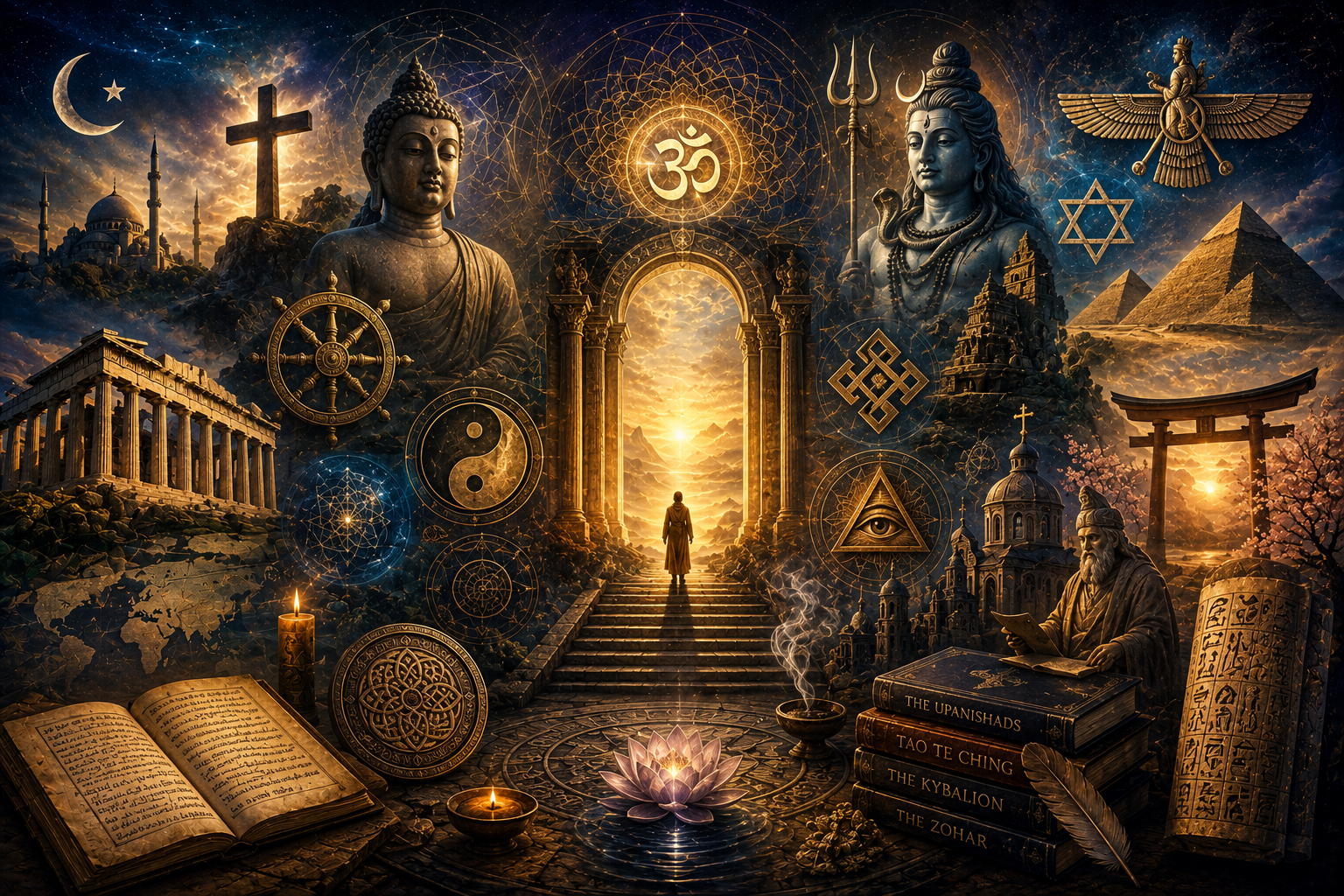
Spirituality, Belief & Esoteric Traditions
Investigating the beliefs, traditions, practices, texts, and metaphysical claims humans have used to understand existence.
Across cultures and throughout history, humans have asked many of the same questions.
Where did we come from?
Is there something beyond the physical world?
What happens after death?
Can humans communicate with the divine?
Do symbols, rituals, astrology, divination, or other systems reveal something meaningful?
Why do similar spiritual ideas appear across different cultures?
Religion, spirituality, mythology, esoteric traditions, and metaphysical systems have offered countless answers.
TRI investigates where those ideas came from, how they developed, what they meant within their original cultures, what evidence exists around their claims, and how those beliefs continue to influence people today.
The question isn't simply:
“Do you believe this?”
It's:
“Where did this belief come from, what does it claim, and what can we actually learn about it?”
Explore the Research ↓
🧭 What You'll Investigate
Spirituality, Belief & Esoteric Traditions explores eight areas:
📜 Religion, Sacred Texts & Spiritual Belief → religions, sacred writings, doctrines, spiritual beliefs, interpretations, and how traditions develop
🏺 Ancient Traditions & Sacred Knowledge → spiritual practices, mythology, cosmology, sacred traditions, and knowledge systems from ancient cultures
🌗 Divine Feminine, Divine Masculine & Sacred Polarity → feminine and masculine divine principles, deities, archetypes, polarity, and their appearances across traditions
🔮 Divination, Astrology & Symbolic Systems → tarot, astrology, numerology, oracle systems, omens, symbols, and methods used to interpret meaning or obtain guidance
🕯️ Magic, Ritual & Energy Traditions → spellwork, ritual, ceremonial practices, folk traditions, energy practices, protection, manifestation, and magical systems
♾️ Afterlife, Reincarnation & Spiritual Reality → beliefs and claims involving death, souls, reincarnation, spirits, other realms, and existence beyond physical life
✨ Modern Spiritual Movements & Metaphysical Claims → contemporary spirituality, manifestation, energy beliefs, channeling, Twin Flames, ascension, and emerging metaphysical movements
🗝️ Hidden Knowledge, Prophecy & Contested Claims → prophecy, secret teachings, forbidden knowledge, lost traditions, suppressed-history claims, and beliefs surrounded by controversy or uncertainty
Religion, Sacred Texts & Spiritual Belief
How have humans tried to understand the divine?
Religions have developed different explanations for creation, morality, human purpose, suffering, death, divine beings, spiritual reality, and what may exist beyond physical life.
Sacred texts can also contain layers of history, theology, law, poetry, symbolism, mythology, philosophy, oral tradition, and later interpretation.
Understanding a religious claim can therefore require more than reading a passage literally.
This area investigates religious history, sacred texts, doctrines, interpretation, translation, archaeology, historical context, spiritual beliefs, and how religious traditions change over time.
-
Why do some writings become scripture while others remain historical, philosophical, or religious literature?
A sacred text is a writing or collection of writings regarded by a religious or spiritual community as having special religious authority, significance, or connection to the divine.
Different traditions understand that sacred status differently.
A text may be considered revealed by a deity, inspired through prophets or spiritual figures, connected to foundational events, or preserved because a community considers its teachings essential.
Sacred status can also develop over time as writings are copied, taught, interpreted, used in ritual, and passed between generations.
What the Evidence Suggests
Texts do not all become sacred through the same historical process.
Religious communities may preserve multiple writings while eventually giving certain texts greater authority than others. Some traditions develop formal canons, while others maintain more flexible collections of sacred literature.
What Remains Important
Calling a text sacred describes its status within a tradition; it does not by itself establish whether its claims are historically or spiritually true.
Those are separate questions requiring different forms of investigation.
TRI Question: How does a religious community move from valuing a spiritual text to treating it as authoritative sacred scripture?
-
When people say a religion “teaches” something, where did that teaching actually come from?
Religious belief can develop through several overlapping sources, including doctrine, tradition, and interpretation.
Doctrine refers to teachings or beliefs formally held by a religious community or institution.
Tradition includes beliefs, practices, rituals, customs, and teachings transmitted through a religious community over time.
Interpretation involves how individuals or communities understand the meaning of sacred texts, doctrines, practices, or religious experiences.
These categories can influence one another.
An interpretation may eventually become part of a tradition, while a longstanding tradition may influence how later generations interpret scripture.
What the Evidence Suggests
Religious teachings are not always derived from one text or source.
Historical development, institutional decisions, cultural context, translation, theological debate, and inherited practices can all influence what a community eventually considers established belief.
What Remains Important
Two groups can accept the same sacred text while reaching different conclusions about what it teaches.
Understanding a religious claim therefore sometimes requires asking not only “Where is this written?” but also “How has this community interpreted it?”
TRI Question: How much of what people understand as religious teaching comes directly from sacred texts—and how much develops through centuries of tradition and interpretation?
Ancient Traditions & Sacred Knowledge
What did ancient cultures believe about humans, nature, the gods, and the universe?
Long before modern scientific institutions, civilizations developed their own systems for understanding existence.
These could include mythology, astronomy, healing traditions, ritual, ancestor practices, sacred calendars, temples, cosmology, divination, philosophy, and relationships with nature.
Some traditions are well documented.
Others survive through fragments, later writings, archaeological evidence, oral traditions, or modern reconstruction.
This area investigates ancient spiritual traditions, mythology, sacred practices, cosmologies, archaeological evidence, historical records, cultural context, and claims about lost knowledge.
-
Are myths simply ancient stories—or were they ways of understanding reality, humanity, and the divine?
Mythology refers to collections of traditional stories through which cultures have expressed ideas about gods, creation, nature, humanity, morality, death, the cosmos, and the meaning of existence.
In everyday language, “myth” sometimes means something false.
In historical and religious studies, however, a myth is not defined simply by whether it is factually true or false.
Myths can communicate a culture's worldview, values, spiritual beliefs, social structures, and explanations for experiences people were trying to understand.
What the Evidence Suggests
Mythological traditions appear across cultures and often address recurring human questions involving creation, death, divine beings, heroes, transformation, order, chaos, and the relationship between humanity and the sacred.
Similar themes can appear even when the details and cultural meanings differ substantially.
What Remains Important
Similarity between myths does not automatically prove that cultures shared one original religion or received the same hidden knowledge.
Researchers must consider cultural contact, independent development, common human experiences, and historical context.
TRI Question: When similar mythological themes appear across different civilizations, are we seeing cultural exchange, shared human concerns, independent development—or some combination of them?
-
How did people understand the part of a person that might exist beyond the physical body?
Ancient cultures developed many different ideas about what today might broadly be called the soul.
These ideas were not identical.
Different traditions described aspects of human existence connected with identity, breath, spirit, life force, consciousness, personality, or a person's continued existence after death.
Some traditions envisioned a part of the individual surviving bodily death, while others described journeys through an afterlife, judgment, rebirth, transformation, or existence within another realm.
What the Evidence Suggests
Beliefs involving some form of nonphysical or continuing human essence appear across numerous ancient religious and philosophical traditions.
Funerary practices, sacred writings, burial customs, ritual objects, and surviving religious texts provide evidence for how particular cultures understood death and continued existence.
What Remains Important
Different cultures did not necessarily mean the same thing when describing what modern readers translate as “soul” or “spirit.”
Applying one modern spiritual definition to every ancient tradition can erase important differences.
TRI Question: Why did so many cultures develop concepts of a human essence extending beyond the physical body—and how different were those concepts when understood in their original contexts?
Divine Feminine, Divine Masculine & Sacred Polarity
Where did ideas about feminine and masculine divine principles come from?
Many traditions have represented divine forces through goddesses, gods, feminine and masculine principles, complementary forces, fertility symbolism, creation stories, sacred unions, and archetypal figures.
But these traditions don't all mean the same thing.
Modern ideas about the Divine Feminine, Divine Masculine, sacred polarity, and energetic union may draw from multiple religious, philosophical, psychological, occult, and contemporary spiritual traditions.
This area investigates goddess and god traditions, feminine and masculine symbolism, archetypes, sacred unions, polarity concepts, historical sources, cultural differences, and modern reinterpretations.
-
What has the feminine face of the divine looked like across human history?
Across cultures, feminine divinity has appeared through goddesses, female deities, sacred mothers, creators, protectors, warriors, healers, rulers, and personifications of nature or cosmic forces.
These figures have not represented one universal idea of “the feminine.”
Some were associated with fertility and motherhood, while others represented sexuality, wisdom, death, justice, sovereignty, war, healing, transformation, or creation.
The feminine divine could be nurturing—but also fierce, destructive, independent, authoritative, or cosmically powerful.
What the Evidence Suggests
Archaeology, mythology, religious texts, temple traditions, and surviving ritual practices show that feminine divine figures have occupied important roles in numerous spiritual traditions.
Examples include traditions surrounding figures such as Inanna and Ishtar, Isis, and other goddesses appearing throughout ancient cultures.
What Remains Important
The existence of powerful goddesses does not automatically establish that a culture was matriarchal or that all feminine deities represented the same spiritual principle.
Each figure needs to be understood within her own historical and cultural context.
TRI Question: What can changing representations of feminine divinity reveal about how different societies understood women, nature, creation, power, sexuality, and the sacred?
-
What qualities have humans associated with the masculine face of the divine?
Across religious and spiritual traditions, masculine divinity has appeared through gods, divine fathers, kings, warriors, creators, protectors, judges, teachers, lovers, and embodiments of natural or cosmic forces.
But masculine divinity has never represented only one type of masculine expression.
Different deities have been associated with order, strength, fertility, wisdom, destruction, protection, law, sexuality, death, rebirth, storms, the sun, kingship, and creation.
Some traditions also portray masculine divine figures in relationship with feminine divine figures, creating symbolic partnerships connected with creation, balance, fertility, or cosmic order.
What the Evidence Suggests
Mythology, sacred writings, ritual traditions, and archaeological evidence document diverse masculine deities across ancient societies.
Their characteristics often reflected both spiritual ideas and the cultural environments in which their traditions developed.
What Remains Important
Modern ideas about masculinity should not automatically be projected backward onto ancient gods.
A masculine deity from one tradition may represent qualities very different from a masculine deity found elsewhere.
TRI Question: What do different representations of masculine divinity reveal about how cultures have understood power, creation, authority, protection, sexuality, and the sacred?
Divination, Astrology & Symbolic Systems
Why have humans repeatedly created systems for interpreting patterns and symbols?
Across history, people have used stars, numbers, cards, dreams, natural events, lots, bones, symbols, and other methods to seek information, guidance, timing, or meaning.
Modern systems include astrology, tarot, numerology, oracle cards, and other forms of divination.
Different questions can be investigated separately:
Where did the system originate?
How has it changed?
What does the symbolism mean?
Can its predictive claims be tested?
Why do people experience readings as accurate or meaningful?
This area investigates divination systems, astrology, numerology, tarot, symbolic interpretation, historical development, psychological explanations, predictive claims, cultural meaning, and available research.
-
Why have humans across different cultures developed methods for seeking guidance from signs, symbols, patterns, and unseen sources?
Divination refers broadly to practices used to seek information, guidance, meaning, or insight through methods believed to reveal something not immediately available through ordinary observation.
Divination has taken many forms across history.
Practices have included astrology, tarot and other card systems, oracle traditions, interpreting dreams, casting lots, observing natural signs, reading omens, and numerous culturally specific methods.
The underlying beliefs behind these practices are not always the same.
What the Evidence Suggests
Historical records show that divination has existed in many societies and has sometimes played important religious, political, and personal roles.
People have consulted divinatory systems when making decisions, interpreting uncertain events, anticipating possible futures, or seeking communication with divine or spiritual sources.
Its widespread historical use establishes divination as a significant human practice—but does not by itself establish that divinatory methods can obtain information beyond ordinary means.
What Remains Important
Different questions require different investigations.
The history of divination, the psychological experience of using it, and whether a particular method produces information beyond chance are separate research questions.
TRI Question: Why have humans repeatedly developed systems for seeking meaning and guidance through signs, symbols, patterns, and practices of divination?
-
When two events feel deeply connected despite having no obvious causal relationship, what exactly are we experiencing?
Synchronicity is a concept most closely associated with psychiatrist Carl Jung and describes meaningful coincidences in which events appear connected by significance rather than an identifiable chain of cause and effect.
A person might think intensely about someone shortly before that person contacts them, repeatedly encounter a symbol during an important life transition, or experience an external event that seems unusually connected to an internal thought or feeling.
What distinguishes synchronicity from an ordinary coincidence is largely the meaning experienced by the person.
What the Evidence Suggests
Coincidences are expected to occur within complex lives containing enormous numbers of events, thoughts, interactions, and opportunities for patterns to overlap.
Human perception is also highly responsive to patterns and personally meaningful information.
These observations can help explain why some coincidences become especially noticeable without necessarily resolving every claim made about synchronicity.
What Remains Important
The experience of meaningful coincidence and the proposed explanation for it should remain separate.
An event can feel profoundly significant without that experience alone establishing an unseen causal mechanism.
TRI Question: Is synchronicity best understood as meaningful pattern recognition within the human mind, evidence of connections we do not yet understand—or a phenomenon requiring several different explanations?
Magic, Ritual & Energy Traditions
Why have ritual and magical practices appeared across so many cultures?
Humans have long used ritual to seek protection, healing, luck, love, fertility, prosperity, communication with spiritual beings, transformation, or influence over circumstances.
Practices have developed through folk traditions, ceremonial magic, religious ritual, occult systems, witchcraft traditions, ancestor practices, and modern metaphysical communities.
Some effects of ritual may be studied psychologically or socially.
Other claims involve proposed spiritual or energetic mechanisms that are more difficult to test.
This area investigates magic, spellwork, ritual, intention, protection practices, folk traditions, ceremonial systems, energy work, historical sources, cultural context, psychological effects, and metaphysical claims.
-
Why do humans repeatedly use structured actions, symbols, words, and objects to mark meaning or create change?
A ritual is a structured sequence of actions performed according to particular customs, traditions, beliefs, or symbolic meanings.
Rituals appear across religious, spiritual, cultural, and everyday life.
They may involve prayer, movement, spoken words, music, candles, herbs, offerings, clothing, sacred objects, repeated gestures, or specific times and locations.
Some rituals are intended to honor a deity, mark a life transition, provide protection, support healing, remember the dead, strengthen community, or influence a desired outcome.
What the Evidence Suggests
Ritual behavior appears across cultures and throughout recorded human history.
Research can examine measurable aspects of ritual—including its relationship with emotion, social bonding, attention, grief, anxiety, perceived control, and performance.
These effects are different questions from whether a ritual can directly influence external events through supernatural or energetic mechanisms.
What Remains Important
A ritual can have psychological, social, cultural, or spiritual significance even when researchers disagree about how its effects should be explained.
Different ritual traditions also should not automatically be treated as interchangeable.
TRI Question: Why is ritual such a persistent part of human culture—and how much of its power comes from belief, symbolism, behavior, community, spiritual experience, or mechanisms not yet established?
-
When people use the word “magic,” are they actually talking about the same kind of practice?
Folk magic and ceremonial magic are broad categories describing different traditions of magical practice.
Folk magic generally refers to practices rooted in local communities, family traditions, cultural customs, healing practices, protection, divination, charms, herbs, household rituals, and practical concerns of everyday life.
Ceremonial magic generally refers to more formally structured systems involving elaborate rituals, specialized symbols, written texts, prescribed tools, spiritual hierarchies, or particular systems of esoteric knowledge.
Neither category represents one universal tradition.
What the Evidence Suggests
Historical magical practices developed within specific religious, cultural, and social environments.
Some were transmitted through written manuscripts and organized esoteric traditions, while others survived primarily through community practice, oral transmission, family knowledge, and local customs.
The boundaries between religion, folk practice, medicine, superstition, and magic have also shifted across cultures and historical periods.
What Remains Important
Modern spiritual practices sometimes combine elements from traditions that originally developed separately.
Understanding their histories requires identifying where particular practices came from rather than treating all forms of magic as one ancient system.
TRI Question: How did different magical traditions develop—and what gets lost when culturally distinct practices are grouped together under the single word “magic”?
Afterlife, Reincarnation & Spiritual Reality
Does consciousness continue after physical death?
Ideas about an afterlife appear throughout human history.
Traditions describe heavens, underworlds, spirit worlds, reincarnation, ancestral realms, judgment, rebirth, liberation, and other forms of continued existence.
Modern investigations also include reported past-life memories, mediumship, deathbed experiences, near-death experiences, apparitions, and other phenomena interpreted as possible evidence of survival after death.
These subjects overlap with other TRI research areas, but here the focus is the larger claim:
Does some part of a person continue after bodily death?
This area investigates afterlife beliefs, reincarnation, past-life claims, mediumship, survival-of-consciousness theories, religious traditions, documented cases, competing explanations, and unresolved evidence.
-
What does it mean to believe that some part of a person can live more than one physical life?
Reincarnation is the belief that after physical death, some aspect of an individual can be born again into another life.
Ideas about reincarnation appear in multiple religious, philosophical, and spiritual traditions, but they do not all describe the process in the same way.
Different traditions may connect rebirth with the soul, consciousness, karma, spiritual development, liberation, or cycles of existence.
Even the idea of what reincarnates varies.
What the Evidence Suggests
Reincarnation has a long history within human religious and philosophical thought.
It is especially associated with traditions originating in South Asia, although beliefs involving rebirth, previous lives, or recurring existence have appeared in other cultures and spiritual movements as well.
Modern researchers have also documented individuals—particularly children—who report memories they interpret as belonging to previous lives.
What Remains Important
The existence of reincarnation beliefs and reports of past-life memories are different from demonstrating that reincarnation itself occurs.
Reported memories can be investigated for accuracy, information sources, cultural influence, psychological explanations, and other possible causes.
TRI Question: What kind of evidence would be necessary to move reincarnation from a spiritual belief or unexplained experience to an empirically supported phenomenon?
-
If someone says they remember another life, how could that claim actually be examined?
Some reincarnation research focuses on people—often young children—who spontaneously report memories they describe as belonging to a previous life.
Researchers may document statements about names, families, locations, occupations, deaths, relationships, or events and then investigate whether those details correspond to a deceased person.
The strongest cases would require more than simply finding similarities after the fact.
What the Evidence Suggests
Researchers can compare statements made before identification of a proposed previous person with independently verifiable records.
They may also investigate when the statements began, who heard them, whether the families had previous contact, how much information was publicly available, and whether details changed during the investigation.
Some documented cases contain unusual correspondences that researchers have argued deserve further examination.
What Remains Important
Possible information leakage, suggestion, selective reporting, memory reconstruction, cultural expectations, coincidence, and investigative bias must also be considered.
An unexplained correspondence does not automatically establish reincarnation.
But dismissing a case without examining its documentation does not explain it either.
TRI Question: Can reincarnation claims be investigated rigorously enough to distinguish ordinary information pathways and psychological explanations from evidence that might suggest something more?
Modern Spiritual Movements & Metaphysical Claims
How do spiritual ideas evolve in the modern world?
Spiritual traditions continue to change.
Contemporary movements may combine ideas from religion, psychology, occult traditions, Eastern philosophies, New Age spirituality, personal experience, social media, and modern self-development.
Ideas such as manifestation, energetic alignment, vibration, channeling, ascension, soul contracts, starseeds, Twin Flames, and other metaphysical frameworks have developed large communities and evolving belief systems.
TRI can investigate these without assuming every claim within them has the same evidentiary status.
This area investigates the origins, development, influences, communities, experiences, psychological dimensions, cultural impact, and metaphysical claims associated with modern spiritual movements.
-
Where did many of the ideas now associated with modern spirituality come from?
The New Age movement is a broad collection of spiritual and metaphysical beliefs and practices that became especially visible in Western culture during the twentieth century.
It is not one organized religion with a single doctrine, leader, or sacred text.
Instead, New Age spirituality has drawn from many sources and commonly includes ideas involving personal spiritual transformation, higher consciousness, energy, astrology, channeling, reincarnation, manifestation, alternative healing, and humanity entering new stages of spiritual awareness.
What the Evidence Suggests
The movement did not emerge from one historical source.
Its development was influenced by earlier esoteric traditions, Spiritualism, Theosophy, New Thought, Eastern religious ideas entering Western culture, alternative religious movements, and later metaphysical communities.
As these ideas circulated, concepts from different traditions were often combined or reinterpreted.
What Remains Important
Not everything described today as “spiritual” or “New Age” originated within the New Age movement.
Some practices have much older histories, while others are modern interpretations or combinations of earlier traditions.
Understanding that history helps distinguish ancient teachings from later spiritual developments.
TRI Question: How much of contemporary spirituality comes from ancient traditions—and how much developed through the modern blending and reinterpretation of different spiritual systems?
-
How did the idea of two people sharing an extraordinary spiritual connection become the Twin Flame framework recognized today?
The modern Twin Flame concept generally describes an unusually intense spiritual connection between two people, often associated with recognition, mirroring, transformation, polarity, separation, reunion, or a shared spiritual purpose.
But the framework recognized today did not appear fully formed in one ancient tradition.
Modern Twin Flame teachings developed within a much larger history of spiritual ideas involving souls, divine counterparts, sacred union, reincarnation, polarity, and spiritually significant relationships.
What the Evidence Suggests
Ideas sometimes connected to Twin Flames can be found across older philosophy, mythology, religion, and esoteric traditions.
However, similarities do not automatically mean those traditions were teaching the modern Twin Flame framework.
Contemporary Twin Flame language has developed through modern metaphysical and spiritual movements, with different teachers and communities adding their own interpretations of what Twin Flames are and how the journey works.
What Remains Important
Historical influence and historical equivalence are not the same thing.
An older story about divided souls, sacred partners, or masculine and feminine deities should not automatically be labeled a Twin Flame teaching simply because it resembles part of the modern framework.
TRI Question: Which parts of modern Twin Flame teachings can actually be traced to earlier spiritual traditions—and which parts developed much more recently?
Continue Investigating
🔮 Psychic & Extrasensory Phenomena → investigate telepathy, clairvoyance, precognition, remote viewing, ESP, and other claimed anomalous abilities
🌌 Extraordinary & Unexplained Experiences → investigate apparitions, NDEs, OBEs, entities, UAP encounters, and other extraordinary experiences
🧠 Consciousness & Human Potential → investigate consciousness, perception, altered states, cognition, and questions about the nature and limits of awareness
🚪 Beyond The Research Institute
🎓 The Divine Academy → when investigating a spiritual concept leads you to explore your own spiritual awareness, beliefs, intuition, energy, signs, practices, or experiences
🌗 Feminine + Masculine → explore feminine and masculine energies as an inner personal framework rather than a research question
♾️ The Twin Flame Journey → explore the Twin Flame framework as a personal connection and journey rather than investigating its history, claims, and development