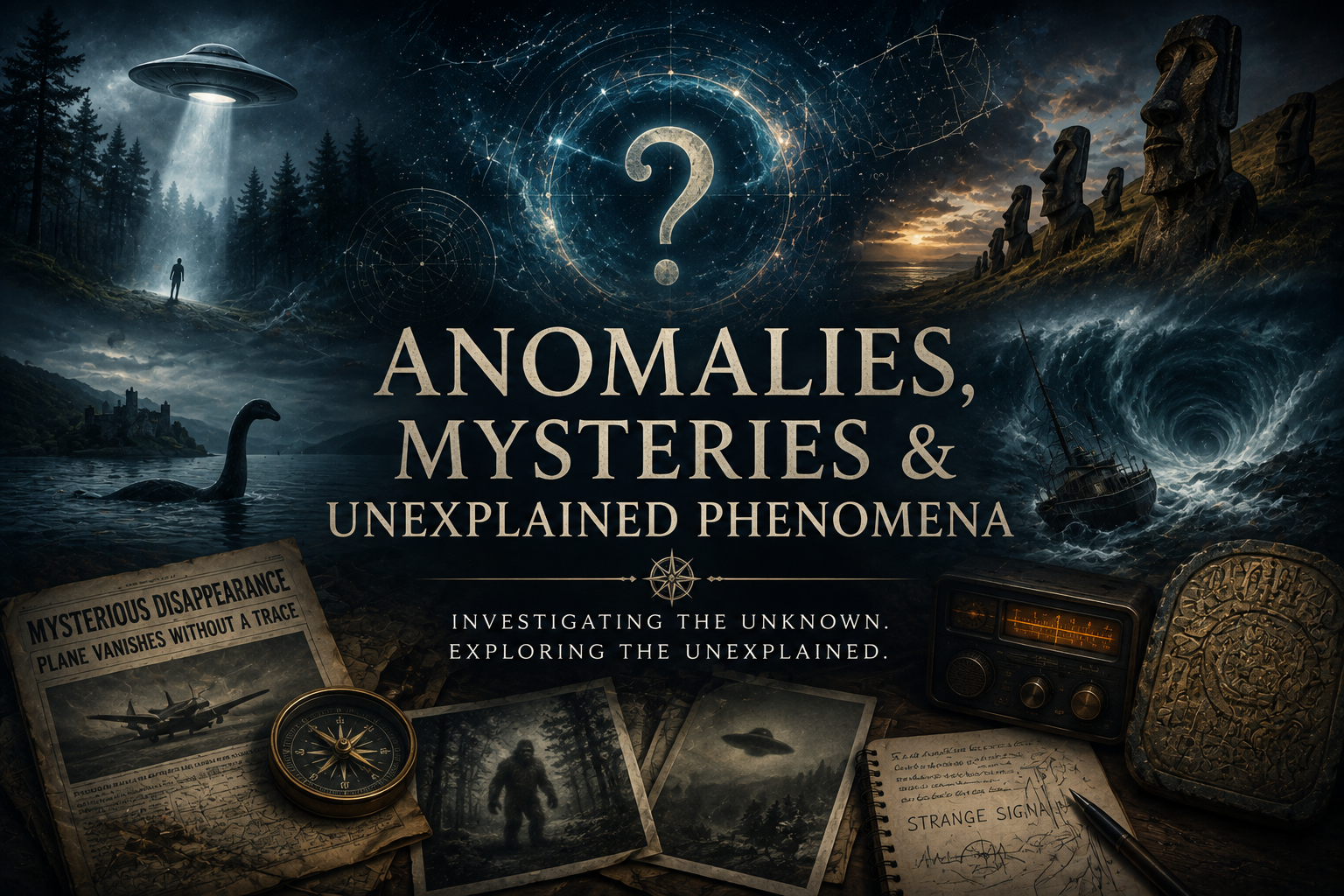
Extraordinary & Unexplained Experiences
Investigating experiences and phenomena that don't always have an obvious explanation.
People across cultures and throughout history have reported experiences that seem to fall outside ordinary expectations.
Seeing an apparition. Feeling an unseen presence. Waking unable to move while sensing something in the room. Experiencing consciousness outside the body. Encountering an unidentified object or unusual being. Watching something happen that seems to challenge our understanding of reality.
Some unusual experiences eventually receive ordinary explanations.
Others remain disputed.
Some simply don't contain enough evidence to determine what happened.
TRI investigates these experiences without requiring them to be either paranormal or impossible from the beginning.
The question is:
“What happened—and how much can we actually explain?”
Explore the Research ↓
🧭 What You'll Investigate
Extraordinary & Unexplained Experiences explores eight areas:
👻 Apparitions, Hauntings & Sensed Presences → reported figures, voices, presences, hauntings, and unusual experiences associated with people or places
🌙 Sleep Paralysis & Nighttime Encounters → paralysis, sensed entities, hallucinations, unusual awakenings, and experiences occurring between sleep and wakefulness
✨ Out-of-Body & Near-Death Experiences → reported experiences of leaving the body, altered consciousness during medical crises, and experiences associated with approaching death
🌀 Reality, Time & Perception Anomalies → déjà vu, missing time, unusual coincidences, time distortions, reality shifts, and experiences that seem inconsistent with ordinary perception
🛸 UAPs & Encounter Experiences → unidentified anomalous phenomena, unusual aerial observations, reported encounters, and the evidence surrounding them
🐾 Cryptids, Entities & Unusual Beings → reported encounters with unidentified creatures, entities, humanoids, and beings that don't clearly fit established categories
⚡ Physical & Environmental Anomalies → unexplained sounds, movements, electrical disturbances, temperature changes, object displacement, environmental readings, and physical effects
🔎 Investigating the Unexplained → how unusual experiences are documented, tested, compared, challenged, and evaluated
Apparitions, Hauntings & Sensed Presences
What are people experiencing when they report a ghost or haunting?
Reports of apparitions and hauntings can include seeing human-like figures, hearing voices or footsteps, sensing an unseen presence, objects appearing to move, repeated activity in a particular location, or feeling watched when no visible person is present.
Possible explanations can vary considerably.
Environmental conditions, perception, expectation, memory, sleep-related experiences, suggestion, building conditions, fraud, coincidence, and psychological factors may explain some reports.
Other cases may remain difficult to resolve with the available evidence.
This area investigates apparitions, sensed presences, hauntings, location-based reports, witness accounts, environmental conditions, physical evidence, conventional explanations, and unresolved observations.
-
What does it mean when someone reports seeing or experiencing a figure that does not appear to be physically present?
An apparition is a reported visual or sensory experience of a person, figure, or presence that does not appear to have an ordinary physical source.
Apparition reports are often associated with ghosts or deceased individuals, but the term describes the reported experience itself, not its cause.
Experiences may involve seeing a complete human figure, a partial form, a shadow-like figure, or something that appears only briefly.
Some reports also include sounds, voices, movement, or a strong sense that another person is present.
What the Evidence Suggests
Apparition experiences have been reported in many settings and cultural traditions.
Researchers can document when they occur, what witnesses report, whether multiple people were involved, and whether environmental, psychological, neurological, or perceptual factors could contribute.
What Remains Important
Seeing an apparition does not by itself establish that a deceased person or paranormal entity was physically present.
The experience can be genuine to the witness while its underlying cause remains uncertain or disputed.
TRI Question: When someone reports an apparition, how can investigators separate what the person genuinely experienced from conclusions about what caused the experience?
-
Why can someone sometimes feel another being nearby even when they cannot see anyone?
A sensed presence is the experience of strongly feeling that another person, being, or entity is nearby despite having little or no direct sensory evidence that someone is physically present.
People may describe feeling watched, accompanied, followed, protected, threatened, or simply aware that “someone else” is there.
These experiences have been reported during bereavement, isolation, extreme environments, sleep-related states, neurological events, spiritual experiences, and situations associated with fear or exhaustion.
They can also occur without an obvious trigger.
What the Evidence Suggests
Sensed-presence experiences are documented human phenomena and can occur under several different circumstances.
The experience itself therefore does not point automatically toward one explanation.
What Remains Important
Psychological, neurological, environmental, sleep-related, cultural, and spiritual interpretations have all been proposed for sensed presences.
Identifying a mechanism in some cases would not automatically explain every report, while an unexplained experience would not automatically establish a paranormal cause.
TRI Question: What creates the powerful perception that another presence is nearby when ordinary sensory evidence does not clearly identify one?
Sleep Paralysis & Nighttime Encounters
Why can waking up sometimes feel like an encounter with something else?
Sleep paralysis occurs when awareness returns while the temporary muscle paralysis associated with REM sleep continues.
During these episodes, people may be unable to move or speak.
Some also report seeing figures, hearing sounds, feeling pressure, sensing someone nearby, or experiencing intense fear.
Many cultures have interpreted these experiences through supernatural or spiritual frameworks.
Understanding the known sleep mechanisms can explain important parts of the experience while still allowing TRI to investigate individual reports carefully.
This area investigates sleep paralysis, hypnagogic and hypnopompic experiences, sensed entities, nighttime apparitions, dream intrusion, cultural interpretations, and unusual sleep encounters.
-
What is happening when someone wakes up aware of their surroundings but temporarily cannot move?
Sleep paralysis is a temporary state in which a person becomes consciously aware while the normal muscle paralysis associated with REM sleep is still present.
During REM sleep, the brain suppresses most voluntary muscle movement—a process that helps prevent people from physically acting out their dreams.
Sometimes awareness returns before this paralysis has completely ended.
A person may feel awake and able to see or hear their surroundings while being temporarily unable to move or speak.
Episodes can also involve pressure sensations, fear, unusual sounds, vivid imagery, or the sensation that another presence is nearby.
What the Evidence Suggests
Sleep paralysis is a recognized sleep phenomenon occurring during transitions between sleep and wakefulness.
It demonstrates that features normally associated with dreaming and waking consciousness can temporarily overlap.
What Remains Important
Understanding the mechanism of paralysis does not mean every detail experienced during an episode has been individually explained.
The intense sensory and emotional experiences accompanying sleep paralysis remain an important area of study.
TRI Question: What happens when waking awareness returns while parts of the brain and body are still operating in a REM-sleep state?
-
Why can waking up unable to move come with the vivid feeling that someone—or something—is in the room?
Some people experiencing sleep paralysis report seeing shadowy figures, human-like forms, intruders, creatures, or other apparent entities.
Others may hear voices, footsteps, breathing, or movement, or simply experience an overwhelming sense that another presence is nearby.
One explanation involves the unusual overlap between REM dreaming and waking awareness.
Dream-related imagery and sensations may continue while the person has become partly aware of their actual surroundings, creating an experience that combines elements of the bedroom with internally generated perceptions.
What the Evidence Suggests
Vivid visual, auditory, bodily, and sensed-presence experiences can occur during sleep paralysis.
Fear and the inability to move may also influence how ambiguous sensations are interpreted.
What Remains Important
Culture can shape how these encounters are understood. Similar nighttime experiences have historically been interpreted as spirits, demons, witches, supernatural attackers, or other entities.
This raises a distinction between the experience itself and the explanation given to it.
TRI Question: Why does the overlap between dreaming and waking so often produce the perception that another intelligent presence is nearby?
Out-of-Body & Near-Death Experiences
What happens when someone experiences consciousness beyond their ordinary sense of the body?
An out-of-body experience, or OBE, generally involves the sensation of perceiving oneself or the environment from a position outside the physical body.
Near-death experiences, or NDEs, are reported during or around life-threatening medical events and may include experiences such as leaving the body, moving through darkness or light, encountering deceased people or beings, reviewing one's life, or experiencing profound peace.
Researchers have proposed neurological, psychological, physiological, cultural, and other explanations.
Questions remain about how completely those explanations account for all reported features.
This area investigates OBEs, NDEs, medical circumstances, consciousness, perception, memory, neurological explanations, reported veridical perception, cultural similarities and differences, and unresolved questions.
-
What do people experience when they come close to death—or believe they have?
A near-death experience (NDE) is a reported set of unusual conscious experiences occurring during or around situations involving actual or perceived proximity to death.
Reports can include feelings of peace, separation from the body, movement through darkness or a tunnel, bright light, encounters with deceased people or other beings, vivid memories, altered perceptions of time, or reaching what feels like a boundary or point of no return.
Not every NDE contains the same features, and people can report very different experiences.
Researchers use tools such as the Greyson NDE Scale to systematically identify and compare commonly reported features.
What the Evidence Suggests
NDEs are documented experiences reported by some people following cardiac arrest and other life-threatening events.
Researchers can study their frequency, characteristics, medical circumstances, and psychological effects without assuming what ultimately causes them.
What Remains Important
The existence of NDE reports does not by itself establish whether consciousness temporarily operated independently of the brain.
Neurological, physiological, psychological, and consciousness-based explanations remain areas of investigation.
TRI Question: What can near-death experiences tell us about consciousness during the extreme conditions surrounding death?
-
What happens when someone experiences their awareness as being located outside their physical body?
An out-of-body experience (OBE) is an experience in which a person feels that their perspective, awareness, or sense of self has separated from their physical body.
People may report viewing themselves from above, observing their surroundings from another location, floating, moving through space, or experiencing their consciousness as existing somewhere outside the body's normal physical position.
OBEs are sometimes reported during near-death experiences, but they are not limited to medical crises.
They can also be reported during sleep-related states, meditation, altered states, neurological events, and other circumstances.
What the Evidence Suggests
Out-of-body experiences are documented subjective phenomena.
Research has also shown that manipulating how the brain integrates visual, spatial, and bodily information can produce experiences involving altered body location or perspective.
What Remains Important
Producing OBE-like sensations through neurological or perceptual mechanisms does not automatically establish the explanation for every reported OBE.
A separate question concerns reports in which people claim to have accurately perceived information they could not ordinarily access.
TRI Question: Does an out-of-body experience represent a change in how the brain constructs the location of the self—or can awareness ever actually obtain information from a perspective outside the body?
Reality, Time & Perception Anomalies
What do we do with experiences that seem to contradict the normal flow of reality?
People sometimes report experiences involving missing time, unusual time distortion, extreme déjà vu, repeated events, impossible coincidences, sudden environmental changes, or the feeling that reality itself briefly shifted.
Some may involve known features of memory, attention, perception, dissociation, neurological processing, or altered states.
Others may be difficult to reconstruct after the fact.
This area investigates time perception, déjà vu, missing time, memory anomalies, coincidence, reality-shift reports, perceptual errors, neurological explanations, and experiences that remain difficult to classify.
-
Why can a completely new moment suddenly feel as though it has happened before?
Déjà vu is the experience of feeling that a current situation is strangely familiar even while recognizing that it should be new.
The term comes from French and means “already seen.”
During déjà vu, a place, conversation, action, or entire moment may briefly feel as though it has already been experienced.
The sensation can be surprisingly convincing even when someone cannot identify an actual previous memory that explains it.
What the Evidence Suggests
Déjà vu is a recognized human experience and has been investigated through research on memory, familiarity, and neurological processes.
One possibility is that systems involved in generating familiarity can sometimes activate without the accompanying retrieval of a specific memory.
Déjà vu has also been studied in neurological cases where it occurs unusually frequently.
What Remains Important
The feeling that a moment has happened before is not the same as demonstrating that it actually has.
The experience raises interesting questions because the mind can apparently produce a powerful sense of recognition without identifying what is being remembered.
TRI Question: What does déjà vu reveal about how the brain decides that something has been experienced before?
-
What happens when many people confidently remember something differently from the documented record?
The Mandela Effect describes situations in which multiple people report sharing the same or similar memory of something that differs from available historical records.
The term became associated with reports from people who remembered Nelson Mandela dying in prison, despite his documented release, later presidency of South Africa, and death in 2013.
Other examples commonly involve remembered wording, logos, names, scenes, cultural events, or details from popular media.
The striking part is not simply that someone remembers incorrectly—it is that many people may report similar incorrect memories.
What the Evidence Suggests
Human memory is reconstructive rather than a perfect recording.
Shared exposure to similar information, expectations, associations, repeated retellings, and features of the original material can sometimes produce similar memory errors across different people.
What Remains Important
A large number of people remembering something similarly does not automatically establish that the remembered version once existed.
But shared false memories remain useful for studying how individual memory can develop surprisingly consistent patterns across groups.
TRI Question: Why can different people independently become confident in the same memory when the available record shows something different?
UAPs & Encounter Experiences
What are people seeing when they report something unidentified in the sky?
An unidentified anomalous phenomenon is something observed that has not yet been confidently identified.
“Unidentified” does not automatically mean extraterrestrial.
Possible explanations may include aircraft, balloons, satellites, drones, astronomical objects, atmospheric phenomena, sensor artifacts, misidentification, classified technology, or insufficient information.
Some cases remain unresolved after investigation.
This area investigates UAP reports, witness accounts, photographs, videos, sensor data, government investigations, possible identifications, encounter reports, competing hypotheses, and unresolved cases.
-
What does it actually mean when something observed in the sky cannot immediately be identified?
UAP stands for Unidentified Anomalous Phenomena, a term used for observations that cannot initially be identified or readily explained.
UAP reports can involve unusual objects, lights, movements, or other phenomena detected visually or through instruments.
The category itself does not identify what caused the observation.
Potential explanations can include aircraft, drones, balloons, satellites, astronomical objects, atmospheric phenomena, sensor effects, misidentification, or other causes.
Some cases may remain unresolved because the available information is simply insufficient.
What the Evidence Suggests
UAP is primarily a classification for something not yet identified, rather than a conclusion that something extraordinary has been discovered.
Investigators can examine witness accounts, photographs, video, radar information, sensor data, environmental conditions, and other available evidence.
What Remains Important
“Unidentified” and “unexplainable” are not necessarily the same thing.
A case may remain unidentified because investigators lack enough reliable information to determine what occurred.
TRI Question: When an observation remains unidentified, what evidence is necessary to determine whether it represents an ordinary phenomenon, an unusual one, or simply a case with insufficient data?
-
If investigators cannot identify something in the sky, what can we actually conclude?
When a UAP remains unidentified, it can be tempting to interpret the absence of an ordinary explanation as evidence of extraterrestrial or non-human technology.
But these are two different conclusions.
“Unidentified” means the available evidence has not established what the observed phenomenon was.
It does not automatically tell us what the phenomenon was instead.
A case can remain unresolved because observations were brief, images were unclear, sensor information was incomplete, witnesses lacked enough viewing information, or investigators could not confidently distinguish among several possibilities.
What the Evidence Suggests
UAP investigations require separating the observation itself from interpretations placed on that observation.
Establishing an extraordinary explanation would require evidence supporting that specific explanation—not simply the inability to establish an ordinary one.
What Remains Important
This distinction works in both directions.
An unresolved case should not automatically be labeled extraterrestrial, but it also should not automatically be assigned an ordinary explanation that the evidence does not establish.
Sometimes the most accurate conclusion is simply unresolved.
TRI Question: What evidence would be required to move a UAP case from “we don't know what this is” to a specific extraordinary explanation?
Cryptids, Entities & Unusual Beings
What are people encountering when they report something that doesn't fit known categories?
Across cultures, people have reported encounters with unusual creatures, humanoid figures, shadow-like beings, unknown animals, and other entities.
Some reports later turn out to involve known animals, misidentification, folklore, hoaxes, environmental conditions, or perception.
Others develop into long-running mysteries because evidence remains limited or contradictory.
This area investigates cryptid reports, entity encounters, eyewitness testimony, folklore, physical evidence, misidentification, hoaxes, environmental explanations, and unresolved cases.
-
What makes a reported creature a cryptid rather than an established animal species?
A cryptid is a creature whose existence has been claimed or reported but has not been scientifically established.
Well-known examples include Bigfoot, the Loch Ness Monster, and other creatures associated with recurring sightings, local traditions, or physical evidence claims.
Cryptids are often studied within cryptozoology, an area focused on searching for animals or creatures whose existence remains disputed or unconfirmed.
A reported creature does not become scientifically recognized simply because sightings are numerous or longstanding.
What the Evidence Suggests
Science establishes animal species through physical evidence that can be independently examined and classified, such as specimens, remains, genetic material, or other sufficiently reliable biological evidence.
Photographs, footprints, eyewitness accounts, recordings, and environmental samples can contribute to an investigation, but their evidentiary value depends on their quality and ability to rule out alternatives.
What Remains Important
An unidentified sighting is not automatically evidence of an unknown species.
Misidentified known animals, unusual viewing conditions, hoaxes, folklore, and incomplete evidence must also be considered.
TRI Question: What level of evidence would be necessary to move a cryptid from reported creature to scientifically established species?
-
When stories describe mysterious creatures, are we investigating a cultural tradition—or an unknown animal?
A creature can exist within folklore without being presented as a scientifically testable biological species.
Folklore includes stories, traditions, beliefs, symbols, and accounts passed through communities and generations.
A zoological claim, however, proposes that an actual biological organism exists or existed in the physical world.
That distinction changes the type of evidence required.
Stories can provide important information about culture, history, recurring descriptions, and how beliefs develop. Establishing an unknown animal requires biological evidence capable of scientific examination.
What the Evidence Suggests
Folklore and biological investigation can overlap.
Reports of unusual animals may influence legends, while existing legends can also influence how ambiguous encounters are remembered, interpreted, and described.
Neither possibility automatically determines what originated first.
What Remains Important
Calling something folklore does not prove that no physical phenomenon inspired the story.
Likewise, a widespread or ancient legend does not establish that the creature described literally exists.
TRI Question: When similar creature stories persist across generations, how can investigators separate cultural transmission from evidence of an actual unidentified organism?
Physical & Environmental Anomalies
What happens when an unexplained experience appears to leave a physical effect?
Some reports involve more than a subjective experience.
People may report unexplained sounds, electrical disturbances, object movement, unusual temperature changes, lights, equipment interference, physical markings, environmental changes, or unusual instrument readings.
Physical claims create opportunities for testing—but they also introduce problems involving equipment reliability, environmental contamination, interpretation, documentation, and reproducibility.
This area investigates reported physical effects, environmental measurements, equipment, natural explanations, documentation, experimental controls, and whether evidence supports the claimed phenomenon.
-
When something unusual is measured or observed in an environment, what does the anomaly actually tell us?
An environmental anomaly is an observation or measurement that appears unusual compared with what would normally be expected in a particular environment.
Examples might include unexpected sounds, electrical disturbances, unusual temperature differences, unexplained movement, electromagnetic readings, or other physical changes.
In paranormal investigations, these events may sometimes be interpreted as evidence of unusual activity.
But an anomaly describes an observation, not its cause.
What the Evidence Suggests
Buildings and environments contain many variables that can produce unexpected effects.
Airflow, plumbing, structural movement, electrical systems, appliances, animals, vibration, weather, acoustics, and equipment limitations can all create observations that initially appear unexplained.
Investigators therefore need baseline measurements and information about the environment before deciding whether something is genuinely unusual.
What Remains Important
Finding an anomaly does not automatically make it paranormal.
At the same time, assigning an ordinary explanation without evidence does not actually explain the observation either.
The cause must be investigated.
TRI Question: When an unusual environmental event is documented, what evidence is needed to determine whether it is ordinary, genuinely anomalous, or simply still unexplained?
-
Can sound that humans cannot consciously hear still affect what they experience?
Infrasound refers to very low-frequency sound, generally below the range of normal human hearing.
Although people may not consciously hear these frequencies as ordinary sound, sufficiently strong low-frequency vibrations can sometimes be detected physically or interact with structures and environments.
Sources can include machinery, ventilation systems, vehicles, weather, industrial equipment, and natural environmental processes.
Infrasound has also attracted attention in investigations of locations where people report unusual sensations or experiences.
What the Evidence Suggests
Low-frequency sound can influence physical environments and, under certain conditions, may contribute to discomfort or unusual bodily sensations.
This has led researchers to investigate whether infrasound could contribute to some experiences reported in allegedly haunted locations.
What Remains Important
The presence of infrasound does not automatically explain an unusual experience.
Investigators would need to establish that relevant frequencies were actually present at sufficient levels and corresponded with what witnesses experienced.
Likewise, failing to find infrasound would not establish a paranormal explanation.
TRI Question: Could an environmental signal outside ordinary conscious hearing contribute to experiences that people interpret as something—or someone—being present?
Investigating the Unexplained
How do you investigate something when you don't yet know what you're investigating?
Unexplained phenomena require careful separation between what was experienced, what was reported, what was recorded, and what has been interpreted.
A witness can sincerely report an experience without necessarily knowing what caused it.
A strange photograph can be authentic without showing something paranormal.
And failing to identify something doesn't automatically establish an extraordinary explanation.
TRI investigations examine witness accounts, timelines, physical evidence, environmental conditions, available records, known explanations, extraordinary hypotheses, contradictions, missing information, and what remains unresolved.
The goal isn't to explain something away.
It's to determine which explanations have actually earned their place.
-
How do investigators examine an extraordinary claim without assuming beforehand what caused it?
Investigating an unexplained experience begins by separating what was actually observed from how that observation was interpreted.
A witness might report hearing footsteps, seeing a figure, noticing an unusual light, losing track of time, or observing an object move.
Those observations can be documented without immediately deciding whether the cause was paranormal, psychological, environmental, technological, or something else.
Investigators can collect witness accounts, photographs, video, measurements, timelines, environmental information, and other available evidence.
What the Evidence Suggests
Strong investigations look for corroborating evidence and test multiple possible explanations.
The timing and quality of documentation also matter. Evidence recorded close to the event can sometimes be more useful than memories reconstructed much later.
What Remains Important
Investigation should avoid beginning with either “this must be paranormal” or “this must have an ordinary explanation.”
Both conclusions require evidence.
Some cases may eventually receive an explanation, while others may remain unresolved because the available evidence is insufficient.
TRI Question: What changes when an unexplained experience is investigated by asking what the evidence supports rather than beginning with what the investigator already believes?
-
If investigators cannot explain something, does that make it evidence of the extraordinary?
When an event is described as unexplained, the term can sound more definitive than it actually is.
In investigation, unexplained generally means that the available evidence has not established a sufficiently supported explanation.
That can happen for several reasons.
Information may be missing. Witness accounts may conflict. Measurements may be incomplete. Video may be unclear. Several explanations may remain possible, or an event may simply not have been documented well enough to reconstruct what happened.
What the Evidence Suggests
An unresolved case demonstrates a limit in the available explanation—not automatically the existence of a paranormal cause.
There is an important difference between “we do not currently know what caused this” and “therefore, something extraordinary caused it.”
What Remains Important
The same caution applies when proposing conventional explanations.
If the evidence does not establish a particular ordinary cause, investigators should not present one as confirmed merely because it seems plausible.
Sometimes unexplained is the most accurate conclusion available.
TRI Question: Can investigators become comfortable enough with uncertainty to leave a case unresolved when the evidence does not justify either an ordinary or extraordinary conclusion?
Continue Investigating
🔮 Psychic & Extrasensory Phenomena → investigate ESP, telepathy, clairvoyance, precognition, remote viewing, and anomalous information
🧠 Consciousness & Human Potential → investigate consciousness, perception, altered states, cognition, and the boundaries of human experience
🏺 Spirituality, Belief & Esoteric Traditions → investigate how cultures and traditions have interpreted spirits, entities, the afterlife, altered states, and extraordinary experiences
🚪 Beyond The Research Institute
🎓 The Divine Academy → when an investigation into extraordinary experiences becomes an exploration of your own spiritual awareness, dreams, intuition, energy, signs, or experiences with the unseen